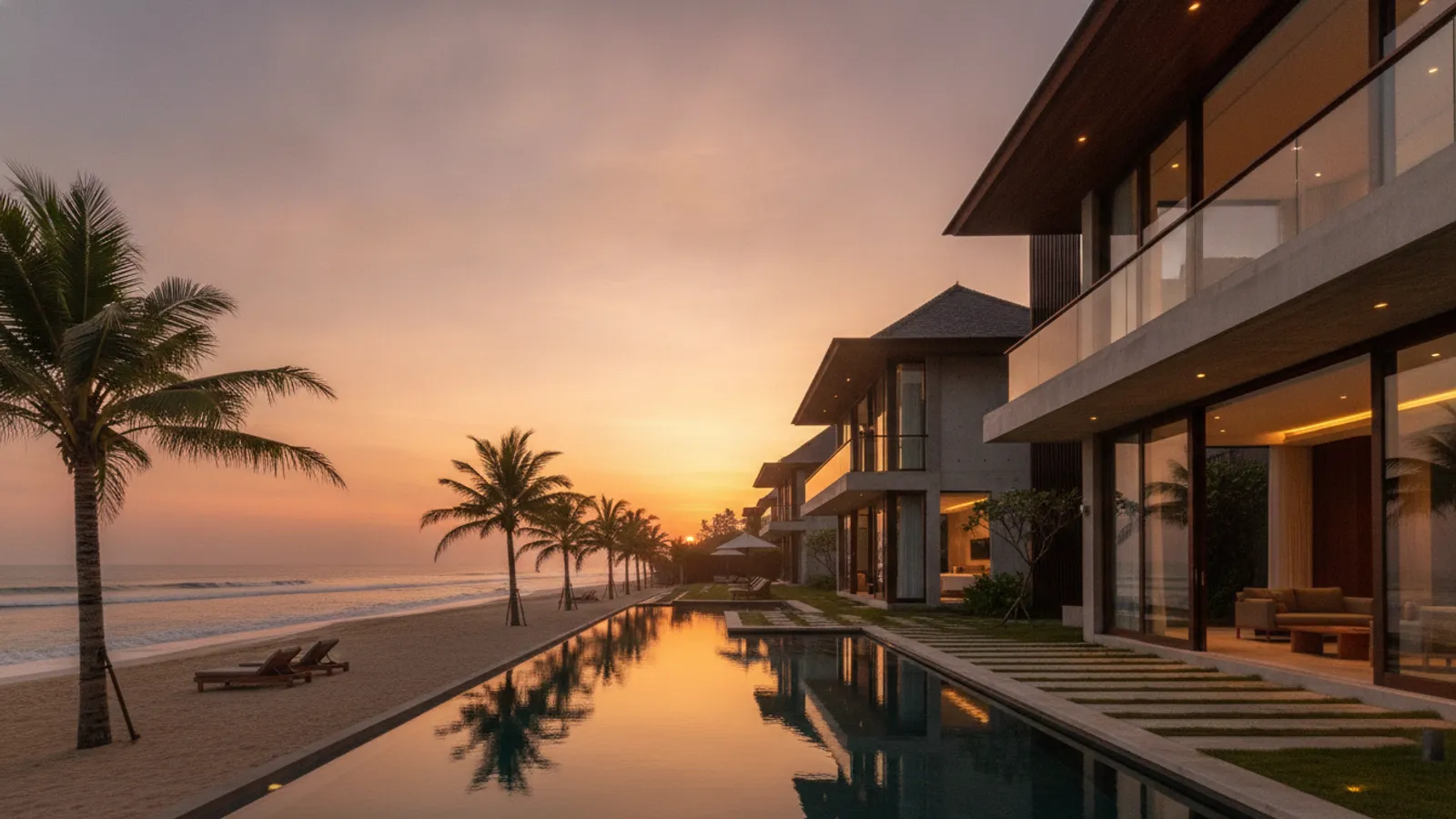
If you are building on Bali in 2026 — a villa in the rice fields, a boutique hotel above a surf break, a co-living block near the beach — sooner or later you need pictures of the thing before it exists. Investors want to see it. Buyers want to walk through it in their imagination. Your Instagram feed needs a hero shot. And so the question comes up, usually late in a planning meeting: who actually does architectural visualization on Bali, and how should we get it done?
The honest answer is that there is no single "right" provider anymore. The market has split into two very different approaches, and each solves a different problem. On one side you have the classic local visualization studio — a small team of 3D artists who take your drawings and hand-craft a set of images over a few weeks. On the other side you have online, automated rendering services that turn a sketch or a model into a finished image in under a minute for around a dollar. Neither is strictly better. They are tools for different moments in a project, and the smartest teams on the island in 2026 use both.
This article walks through how each option actually works — approach, pricing, timelines, and the real tradeoffs — and then shows you the hybrid workflow that most experienced architects and developers on Bali have quietly settled into. Every figure below is indicative, meant for planning conversations rather than a fixed quote; real prices depend on scope, revisions, and how finished your input material is.
The Two Ways to Get Visualization Done on Bali
Before comparing them in detail, it helps to name the two categories cleanly, because they are genuinely different businesses rather than cheaper-and-more-expensive versions of the same thing.
A local visualization studio is a service business built around human craft. You brief a team, they interpret your project, and skilled artists produce bespoke images. The value is in judgement, taste, and art direction. You are paying for people and their time.
An online automated service is a software product. You upload a sketch, photo, or 3D export, describe what you want in plain language, and the system generates a photorealistic image. The value is in speed, price, and the ability to iterate endlessly without waiting on anyone. You are paying for compute and a good interface.
Bali complicates both in interesting ways. It is a small island with a big design reputation, so the local studio scene is real but thin — genuinely talented artists exist here, but there are not many of them, and the good ones are often booked. Meanwhile the island's building boom means an enormous volume of projects that need visuals fast and cheap, which is exactly the gap online services fill. If you are mapping the market by area — from the design-agency density of Seminyak to the villa-heavy clifftops of Uluwatu — you can see both patterns overlaid on the same geography. Our Bali visualization overview breaks down how demand differs across the island.
How Local Bali Visualization Studios Typically Work
Picture the standard engagement. You come to a studio with your architect's drawings — plans, elevations, maybe a rough 3D model. You have a kickoff call or meeting where you explain the concept, the mood, the materials, the light you are imagining. A project manager scopes the work: how many images, which views, interior or exterior, day or dusk, and how many rounds of revision are included.
From there the artists get to work. They build or clean up a 3D model, set up cameras, place materials, dress the scene with furniture and planting, and then light it. On Bali specifically, good studios lean hard into the things that make island architecture photograph well — the interplay of teak and stone, water features catching light, the transition between covered and open space, tropical planting that reads as lush rather than generic. This is craft, and it takes time. A single hero exterior of a villa can absorb days of an experienced artist's attention.
The strengths of the studio approach
The reason studios still command premium fees is that they deliver things automation cannot easily match:
- Bespoke art direction. A good studio does not just render your building; it composes an image. Where the camera sits, how the eye travels, what is in shadow, what glows — these are deliberate authorial choices. For a marquee project that will define a brand, that authorship is worth a lot.
- Hyper-detailed, controlled scenes. Every material, every reflection, every leaf can be dialed in precisely. If the client insists the pool coping is a specific Javanese stone in a specific finish, a studio can model exactly that.
- Consistency across a set. When you need twelve images that all feel like one coherent world — same light, same styling language, same quality bar — human oversight keeps the set unified in a way that is hard to guarantee otherwise.
- Complex or unusual geometry. Cantilevers, split levels tumbling down an Uluwatu cliff, intricate roof structures — a studio can handle geometry that is genuinely difficult to describe in words.
The tradeoffs
None of that is free, and the costs are not only financial:
- Price. Bespoke work is priced per image and per artist-hour. For a set of polished stills on a villa or boutique hotel you should expect a meaningful four-figure budget, and larger or luxury projects climb well beyond that. Indicative, but real.
- Timelines measured in weeks. Because the work is manual and studios juggle several clients, a full package typically takes anywhere from a couple of weeks to well over a month from brief to final delivery. If your investor call is Thursday, a studio is not your answer for Thursday.
- Per-revision friction. Contracts usually bundle a fixed number of revision rounds. Want to try the facade in a darker stone, then change your mind, then try it at dusk instead of noon? Each exploration beyond the included rounds is billable, so experimentation gets expensive and people become reluctant to explore.
- Scheduling. The best island artists are booked. Getting into their calendar can itself add weeks before any work begins.
Studios, in short, are superb when you know what you want, the project deserves magazine-grade imagery, and you have the budget and the runway to wait. They are a poor fit when you are still exploring, moving fast, or working on a tight budget.
How Online and Automated Services Work
The online model inverts almost every one of those properties. Instead of briefing a team, you interact with software directly. The typical flow with an automated service like Tropico Render looks like this: you upload an input — a hand sketch, a SketchUp or Revit screenshot, a clay 3D render, even a rough massing model — and you type what you want in ordinary language. "Modern Balinese villa, teak and volcanic stone, infinity pool, golden hour, lush tropical planting." A few seconds to a minute later, a photorealistic image comes back. Around a dollar. In the browser, no software to install, no 3D pipeline to maintain.
If you want to change something, you do not open a ticket or wait for a revision round. You edit the text and generate again. Darker stone, then lighter. Noon, then dusk. Pool on the left, then centered. Each iteration is another dollar and another minute. You can run twenty variations of a facade over a coffee.
The strengths
- Speed. Thirty to sixty seconds per image changes what visualization is for. It stops being a deliverable you commission at the end and becomes a thinking tool you use throughout design.
- Price. At roughly a dollar per render, the cost of trying an idea drops to almost nothing. A whole afternoon of exploration costs less than a single studio revision.
- Unlimited iteration by text. Because you steer with language, exploring the design space is effectively free. This is the single biggest behavioural difference — people explore far more when exploring is cheap.
- Browser-based and always available. No render farm, no specialist software, no scheduling. A developer, a broker, or an architect's assistant can produce presentable images without any 3D training. That matters on Bali, where teams are lean and turnaround expectations are brutal.
- Volume. Need forty images for a listing portfolio, or a variation of every room in three styles for different buyer segments? Automation does volume without the price scaling linearly the way artist-hours do.
The tradeoffs
Automation is not magic, and it is important to be honest about where it gives ground:
- Less bespoke art direction for hero shots. For the one image that has to be perfect — the cover of the brochure, the billboard, the shot that defines the whole development — a human art director composing every element still has an edge. Automated results are excellent and often indistinguishable in a feed, but the last five percent of deliberate composition is where studios keep their advantage.
- Precise material fidelity has limits. If a specific named stone in a specific finish is contractually non-negotiable, describing it in text is less certain than a studio modelling the exact material.
- Complex geometry needs good input. The better your input sketch or model, the better the result. Very unusual geometry described only in words can be harder to nail than it would be for an artist working from full drawings.
For the honest majority of a project's visual needs — concepts, iterations, pitch decks, social content, listing images, buyer-facing variations — those tradeoffs simply do not bite. You can see how this plays out for specific island contexts in our guides to Seminyak visualization and Uluwatu clifftop projects, where speed and volume tend to matter more than a single perfect frame.
Side by Side: Local Studio vs Online Service
The table below lays the two approaches next to each other on the dimensions that actually decide which one you reach for. Treat the figures as indicative planning numbers, not quotes.
| Dimension | Local studio | Online service |
|---|---|---|
| Turnaround per image | Days, full sets in weeks | 30–60 seconds |
| Indicative price | Hundreds to thousands per image | ~$1 per render |
| Revisions | Fixed rounds, extra rounds billable | Unlimited, edit text and regenerate |
| Art direction | Bespoke, human-composed | Guided by your text prompt |
| Material precision | Exact, modelled to spec | Very good, described in language |
| Complex geometry | Handles the hardest cases | Depends on quality of your input |
| Consistency across a set | Human-managed, tightly unified | Strong with consistent prompting |
| Access / scheduling | Booking and lead time required | Instant, browser-based, always on |
| Skill required | Studio handles it | Anyone can operate it |
| Best for | Marquee hero imagery, luxury launches | Concepts, iteration, volume, speed, social |
Read the table as a map of when, not which is better. The columns rarely compete for the same job. One is a scalpel for a single defining image; the other is the everyday tool you use hundreds of times across a project.
The Hybrid Workflow: Use Both, at the Right Moment
Here is what experienced architects and developers on Bali actually do in 2026. They stopped treating this as a choice and started treating it as a sequence. The pattern is consistent enough that it is worth spelling out step by step.
Early design and concept. When the building is still an idea, they use online automated rendering to think. The architect sketches a massing, uploads it, and generates a dozen directions in an afternoon — this facade in stone versus timber, this roofline steep versus flat, this orientation catching morning versus evening light. At a dollar each, exploring is free, so they explore properly instead of committing early to save render budget. Decisions get made against pictures rather than against imagination.
Client and investor iteration. When the client wants changes — and the client always wants changes — those changes happen live. "Can we see it darker? With a bigger pool? At sunset?" Instead of "that will be another revision round, give us a week," the answer is a new image in a minute, in the meeting, while everyone is still in the room. This alone transforms client relationships, because the frustrating lag between feedback and result disappears.
Pitch decks and fundraising. Off-plan projects on Bali live or die on the deck. Teams generate a full set of interior and exterior images, try them across styles for different investor audiences, and assemble a polished deck for a fraction of what a studio set would cost — fast enough to tailor the visuals to each specific pitch.
Marketing and social. The island's property marketing runs on Instagram, and social is a bottomless pit of image demand. Automated renders feed it endlessly: variations, room-by-room walkthroughs, seasonal and lighting variants, buyer-segment-specific styling. No studio budget survives contact with a content calendar; automation was built for exactly this volume.
The one or two final hero shots. Then — and only then — for the images that truly must be flawless, some teams still commission a studio. The brochure cover. The billboard on the bypass. The single frame that anchors a luxury launch. By this stage the design is locked, the composition is already validated through dozens of automated explorations, and the brief to the studio is razor-sharp. That precision makes the studio engagement faster, cheaper, and better, because you are no longer paying an expensive artist to figure out what you want — you already know, and you can show them exactly.
Notice what the hybrid does. It sends each job to the tool that fits it. Automation absorbs the ninety-plus percent of visual work that is about speed, iteration, and volume, where its economics are unbeatable. The studio is reserved for the rare cases where bespoke human art direction genuinely moves the needle — and even there, it works better because the automated phase did all the exploring first. You get the studio's polish where it counts without paying studio prices and studio timelines for everything else.
For many projects on Bali, the honest truth is that the hero-shot studio step never even happens. The automated images are good enough for the entire lifecycle — concept to sale — and the project ships without a single manual render. For a luxury villa or a flagship hotel, the final studio pass earns its keep. The point of the hybrid is that you decide deliberately, per image, instead of defaulting to the expensive path for everything or the cheap path for the one shot that deserved more.
How to Choose for Your Project
A few practical rules of thumb to close on:
- If you are still exploring the design, start automated. Do not spend studio money to discover what you want. Explore cheaply first, decide, then commission only if a hero shot demands it.
- If your deadline is this week, go automated. Studios cannot compress weeks into days. Automation delivers in minutes.
- If you need volume — listings, social, buyer variations — go automated. The economics are not close.
- If a single image must be genuinely magazine-grade and the budget and timeline exist, add a studio pass for that image only. Do it after your automated exploration has locked the design, so the brief is precise.
- For almost everything in between, the hybrid wins. Automated for the many, studio for the rare few — that is the workflow that has quietly become standard on the island.
Bali's building boom is not slowing down, and neither are the expectations of the buyers and investors funding it. The teams that win are the ones who can show a compelling image today, iterate on it live tomorrow, and reserve their premium budget for the one frame that truly deserves it. That is not a studio strategy or an online strategy. It is both, sequenced well.
If you want to feel how fast the automated half of that workflow really is, try it on your own project. Upload a sketch, describe your Bali villa, and see a photorealistic render come back in under a minute.