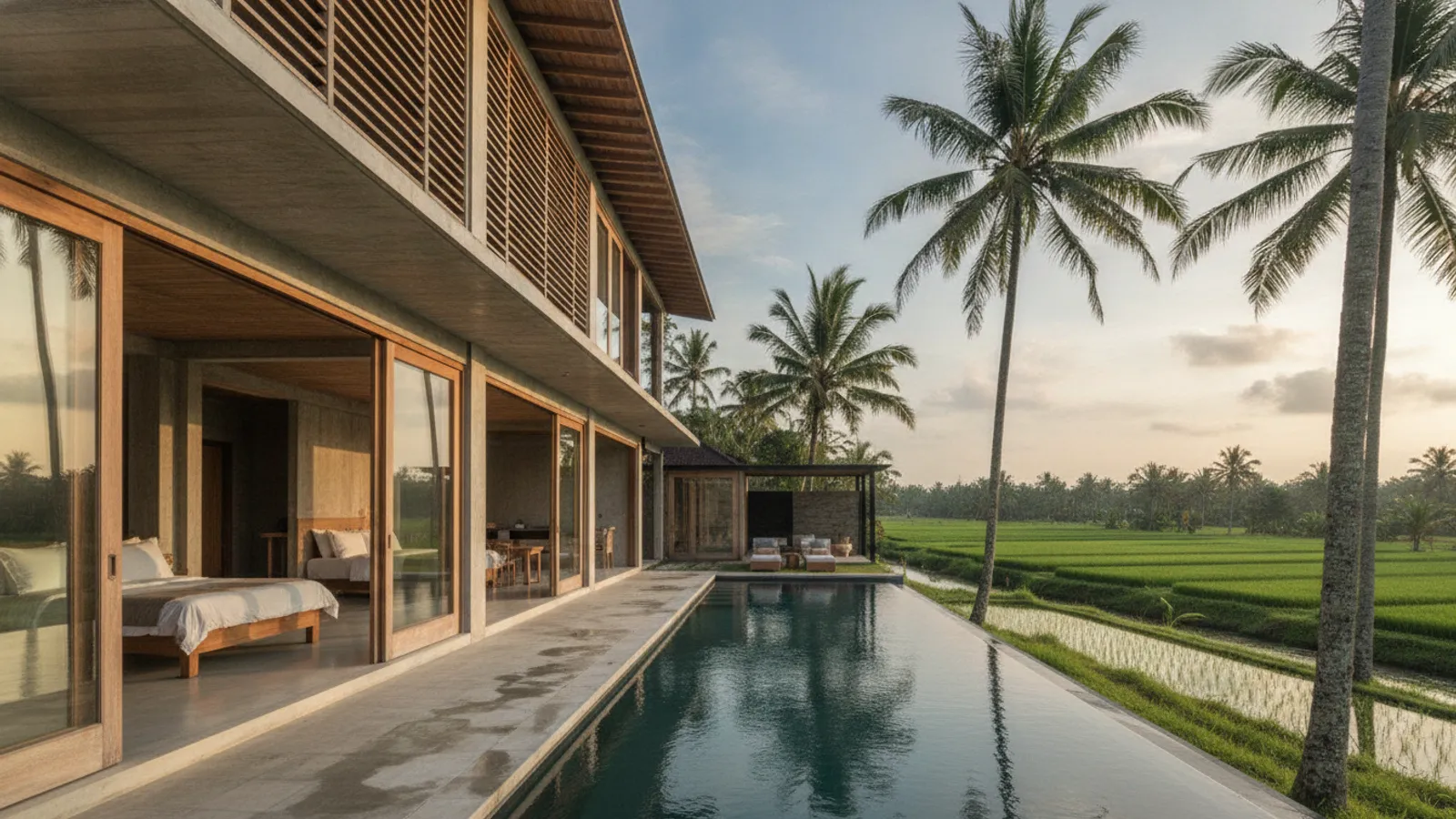
Bali has spent the last decade quietly turning into one of the most talked-about property markets in Southeast Asia. What used to be a surf-and-yoga destination is now a place where developers break ground on boutique villa clusters every month, where digital nomads sign year-long leases, and where investors from Jakarta, Singapore, Sydney, Moscow and Dubai compare rental yields the way traders compare tickers. If you are reading this in 2026, you are arriving at an interesting moment: the market is more mature than it was five years ago, prices in the prime zones have climbed, and yet the fundamentals that made Bali attractive — tourism demand, a growing remote-work population, and construction costs still a fraction of Western markets — are all intact.
This guide is a practical starting point. It is not legal advice and it is not a promise of returns. It is an honest map of where the money tends to flow, what kind of buyer each area attracts, what returns people actually talk about, and where the risks sit. Toward the end we will also talk about something most investment guides skip: how you actually sell a Bali project to investors when it does not exist yet, and why fast, cheap visualization has become one of the quiet levers that separates a villa that sells off-plan in weeks from one that sits half-funded for a year.
Why Bali in 2026
The case for Bali is really a case about three curves that keep pointing up.
The first is tourism. After the disruptions of the early 2020s, Bali's visitor numbers recovered and then kept climbing, with the island now regularly hosting well over six million international arrivals a year on top of a huge domestic Indonesian travel market. More visitors means more nights booked, and short-term rental occupancy is the engine behind most villa investment returns.
The second is the remote-work migration. Indonesia's introduction and refinement of longer-stay and remote-worker visa options has turned Bali from a two-week holiday into a six-month base for tens of thousands of location-independent professionals. These people do not want a hotel room. They want a villa or an apartment with a pool, fast internet, and a kitchen — and they will pay monthly rates a family on a one-week holiday never would.
The third is the supply-and-cost gap. Land in the prime zones has appreciated significantly, but construction costs remain low by global standards. A developer can still build a well-finished two-bedroom villa for a total cost that would barely buy a parking space in central London or Singapore. That spread between build cost and achievable rental income is the entire reason the yields below are possible.
Put simply: demand keeps rising, the cost base stays comparatively low, and the buyer pool has broadened from holidaymakers to long-term residents and international investors. That is why Bali is still on the table in 2026. Start with the Bali market overview if you want the wider context before drilling into specific areas.
A word of realism, though. "Still attractive" is not the same as "risk-free." Prices in Canggu are no longer the bargain they were in 2018. Regulation around foreign ownership, zoning and short-term rentals is tightening in places. And a market this hot for this long will always attract some overbuilding and operators who overpromise. The winners in 2026 are the investors who go in with clear eyes, the right structure, and a realistic yield expectation — not the ones chasing the numbers from a brochure.
Key investment areas
Bali is not one market. It is a cluster of micro-markets, each with its own buyer, price ceiling, and rental dynamics. Three areas dominate the conversation for investors, and understanding who buys in each is more useful than any single price figure.
Canggu
Canggu is the beating heart of the modern Bali investment story. Over the last ten years it went from rice fields and a handful of surf breaks to the island's most concentrated cluster of cafes, co-working spaces, beach clubs and boutique villas. It is where the digital-nomad wave landed hardest, and that shapes everything about the investment case.
Who buys here: first-time Bali investors who want the safest bet on rental demand, and operators building small villa clusters aimed at the monthly-rental market. The tenant is usually a remote worker, a couple on a long stay, or a rotation of short-term holiday guests. Because demand is so deep and year-round, Canggu villas tend to have the highest and most reliable occupancy on the island.
The trade-off is price and competition. Canggu land is now the most expensive of the three areas here, so your entry cost is higher and your gross yield is compressed by that higher price. You are also competing against a lot of well-marketed villas, which is exactly why presentation matters so much — more on that later. Typical returns discussed for Canggu sit in the high-single-digit to low-double-digit gross yield range for a well-run villa, with the appeal being reliability rather than a bargain entry. The Canggu area guide goes deeper into sub-zones like Berawa, Pererenan and Babakan, which increasingly matter because central Canggu is close to saturated.
Uluwatu
If Canggu is about volume and reliability, Uluwatu is about premium and view. Perched on the cliffs of the Bukit Peninsula in the south, Uluwatu offers dramatic ocean panoramas, world-class surf, and a more exclusive, design-led atmosphere. Development came later here than in Canggu, which means there is still land with genuine upside, and the ceiling on villa pricing is higher because the product is more aspirational. Investment focus is actively shifting away from an overheated Canggu toward the Bukit Peninsula (Uluwatu, Bingin, Ungasan) — where land with upside still exists and the premium segment is less saturated.
Who buys here: investors targeting the luxury short-term rental segment, and buyers who want a trophy villa that also earns. The guest paying for an Uluwatu clifftop villa is on a higher-budget holiday, a honeymoon, or a group booking a statement property. Rental rates per night can be substantially higher than Canggu, but occupancy is often more seasonal and more dependent on the quality and view of the specific property.
The trade-off is that Uluwatu rewards the right site and the right design far more than Canggu does. A villa with a clean ocean view and a strong architectural identity can command premium rates; an average villa set back from the cliff struggles to justify the price. This is a market where the look of the finished product is a big part of the value, which makes early visualization particularly important for off-plan sales. Returns in Uluwatu cover a wide band because the product varies so much, but a well-positioned luxury villa can reach attractive gross yields while carrying stronger capital-appreciation potential as the area matures. See the Uluwatu area guide for the cliffside sub-areas and access considerations.
Ubud
Ubud is the outlier, and deliberately so. Inland, green, and centered on wellness, culture and nature, it attracts a completely different guest and a completely different investor. Where Canggu sells nightlife and surf and Uluwatu sells cliffs and status, Ubud sells jungle, rice-terrace views, yoga retreats, and a slower, more restorative kind of stay.
Who buys here: investors targeting the wellness and retreat market, and buyers who personally value tranquility over the beach scene. Tenants are often on longer, more intentional stays — wellness travelers, writers and creatives, families wanting quiet. Land is generally cheaper than in the coastal prime zones, which improves the entry math, and a distinctive villa surrounded by jungle can achieve strong rates in the wellness niche.
The trade-off is that Ubud demand is more niche and can be more seasonal, and the wellness positioning has to be genuine — this is not a market where a generic villa performs well. It rewards a strong concept and a strong sense of place. Because so much of Ubud's appeal is atmospheric — how the villa sits in the greenery, how the pool meets the jungle — it is another market where visualization does heavy lifting while the villa is still a construction site. The Ubud area guide covers the surrounding villages where much of the newer development is happening.
Leasehold vs freehold basics
This is the part where every serious Bali guide has to slow down and add a disclaimer, so here it is plainly: what follows is a high-level orientation, not legal advice. Foreign property ownership in Indonesia is genuinely nuanced, the rules evolve, and you should engage a qualified Indonesian notary and lawyer before signing anything. With that said, here is the shape of it.
Foreigners generally cannot hold freehold title (Hak Milik) directly in Indonesia. That is the strongest form of ownership and it is reserved for Indonesian citizens. So when you hear about a foreigner "buying freehold" in Bali, it almost always involves a structure rather than direct personal title.
Leasehold is the most common and straightforward route for foreign investors. You lease the land and property for a fixed term — commonly 25 to 30 years, often with an agreed option to extend. During the lease you have the right to use, rent out, and benefit from the property. Leasehold is simpler, faster, and carries less structural complexity, which is why the majority of foreign villa investments are done this way. The obvious consideration is the finite term: the clock is running, and the value and extension terms as the lease shortens must be part of your math from day one.
Freehold via a structure typically means using an Indonesian legal entity (a foreign-owned company, PT PMA) or another arrangement that allows a form of long-term control closer to ownership. This can suit larger or longer-horizon investors building a portfolio, but it comes with setup costs, ongoing compliance, and more moving parts.
The practical takeaway: most people starting out in Bali go leasehold because it is cleaner and the entry is lower, while larger investors more often justify the freehold-via-structure route. Neither is universally "better" — it depends on your horizon, capital, and risk appetite. And again: this is a summary, not advice. Get the paperwork checked by professionals who do this every week.
ROI and rental yields
Now the numbers everyone actually wants. A caution first: the figures below are indicative — the ranges people commonly discuss for well-run properties, not guarantees. Actual returns depend on your purchase price, build quality, management, occupancy, and the ever-present variable of how well the property is marketed. Two identical villas next door to each other can post very different yields based purely on how professionally they are presented and operated.
With that caveat, here is a rough orientation of where the numbers tend to land by area and segment:
| Area | Segment | Indicative gross rental yield |
|---|---|---|
| Canggu | Mid-market villa (short + monthly rental) | 9–12% |
| Canggu | Premium villa (design-led, monthly focus) | 8–11% |
| Uluwatu | Luxury clifftop villa (short-term) | 10–14% |
| Uluwatu | Mid-market villa (set back from cliff) | 7–10% |
| Ubud | Wellness / retreat villa | 8–12% |
| Ubud | Standard villa (no strong concept) | 6–9% |
An important distinction: the figures above are gross yields, before operating costs. Net yield — after management, utilities, taxes, depreciation and OTA commissions — typically runs at 50–70% of gross, i.e. roughly 4–8% for a typical mid-market villa and 5–9% for a luxury villa under good management.
A few things to read into that table. First, the headline gross yields across Bali look high next to mature Western markets, where even a net yield of 4–5 percent is considered good; but compare like with like — on a net basis (see above) Bali's edge is real, just far more modest than the headline figures suggest. Second, the spread within each area is wide, and the difference between top and bottom is almost entirely about execution: the right location within the zone, a strong design, good management, and effective marketing. Third, yield is only half the return. Well-chosen Bali property has also delivered capital appreciation on top of rental income, especially in maturing areas like Uluwatu — though appreciation is never guaranteed.
The honest summary: Bali can produce yields that look extraordinary next to London or Sydney, but the top of the range is earned through good buying, building, operating and selling — not handed out automatically.
2026 demand drivers
What is actually pushing the market in 2026, specifically? A few forces stand out.
The remote-work base keeps deepening. The nomad wave is no longer a novelty; it is a structural part of Bali's economy. As remote and hybrid work stays normalized, the pool of people who can spend three, six or twelve months on the island keeps growing, and they overwhelmingly want villas over hotels. This underpins the monthly-rental demand that makes Canggu and increasingly Uluwatu so resilient.
The market is professionalizing. Management companies, branded villa operators, and more sophisticated developers have raised the baseline. That is good for investors who buy well-run product and tougher for amateurs — the days of any villa filling itself just by existing are ending.
The premium and wellness segments are pulling ahead. As the mid-market gets crowded, differentiated product — luxury clifftop villas, genuine wellness retreats, design-forward homes — is where pricing power and margin increasingly sit. This favors Uluwatu and concept-driven Ubud projects, and it raises the stakes on design and presentation.
Off-plan buying is accelerating. With prime land scarce and prices rising, more investors are committing to villas before they are built, locking in earlier pricing. That shift is hugely important for developers, because it moves the entire sales process to a stage where there is nothing physical to show — only a plan, a plot, and a vision. Which brings us to the part of this guide that most others ignore.
The role of visualization when selling off-plan
Here is a truth every Bali developer learns fast: it is much harder to sell something that does not exist yet. When an investor is deciding whether to put down capital on a villa that is currently a patch of cleared land and a set of drawings, they are being asked to buy a feeling — the light coming through the living space at sunset, the pool meeting the jungle, the ocean view framed by the terrace. A floor plan does not create that feeling. A photorealistic image does.
This matters more in Bali than in almost any other market, because so much of a Bali property's value is emotional and atmospheric. We saw it in each area above: Uluwatu is sold on the view, Ubud is sold on the setting, and even in Canggu the difference between a fast sale and a slow one is often how vividly a buyer can picture living there. Investors are more rational than end-users, but they are still human, and they are imagining how their future guests will react to the listing photos. A project that can show a stunning, believable render gives the investor confidence on two fronts at once: this is what I am buying, and this is what will fill it.
The problem has always been that good visualization was slow and expensive. Commissioning a traditional 3D studio typically meant briefing, waiting one to three weeks, paying hundreds of dollars per image, and then paying and waiting again for every round of revisions. For a developer launching a sales campaign, that timeline is a real drag. The renders often arrive after the momentum has cooled, and the cost means you only produce a handful of angles rather than the full set that actually sells.
How automated renders shorten the sales cycle
This is exactly the gap Tropico Render is built to close. Instead of treating a render as a slow, expensive, one-off deliverable, we treat it as something you generate on demand — a photorealistic image from your design in roughly 30 to 60 seconds, for about one dollar per render, with revisions you iterate on live rather than emailing back and forth for a week.
Think about what that does to the off-plan sales cycle.
Launch faster. The moment your design is ready, you can have a full set of presentation-quality renders the same day, not three weeks later. When an investor expresses interest, you are not saying "let me commission some visuals" — they already exist, and the conversation stays warm.
Iterate in the meeting, not over email. An investor asks what the villa looks like with a darker stone, a bigger pool, or the living space opened to the view. With automated rendering you can regenerate the image while the interest is live, at a dollar a shot, instead of quoting a revision fee and a week's delay. That responsiveness is itself a selling signal — it tells the buyer this is a serious project.
Show every angle, not just three. When each render costs a dollar instead of several hundred, you stop rationing images. You show the exterior at golden hour, the pool deck, the master bedroom, the view from the terrace, the whole story. More complete visual coverage means fewer unanswered questions in the buyer's mind, and that means a faster decision.
Test and market cheaply. You can produce variations for different investor audiences, for social ads, for listing platforms and for pitch decks without every image blowing a hole in the marketing budget. In a professionalizing market where presentation increasingly separates winners from also-rans, that is a genuine edge.
The math is simple. A traditional studio render might cost a few hundred dollars and take a couple of weeks; the same visual from Tropico Render costs about a dollar and takes under a minute. Multiply that across the dozens of images a real sales campaign needs, and the difference is not incremental — it changes how you sell. Developers who can visualize instantly and cheaply move faster, present more completely, and close off-plan investors before the enthusiasm fades. In a market where more and more villas are sold before a single wall goes up, that speed is quietly one of the most valuable tools a developer can hold.
Bali in 2026 is still a strong market for people who go in prepared — the right area, the right structure, a realistic yield expectation, and, when it comes time to sell, the ability to make the finished villa feel real long before it is. Get the fundamentals right, present the project brilliantly, and the island's underlying demand does much of the rest.