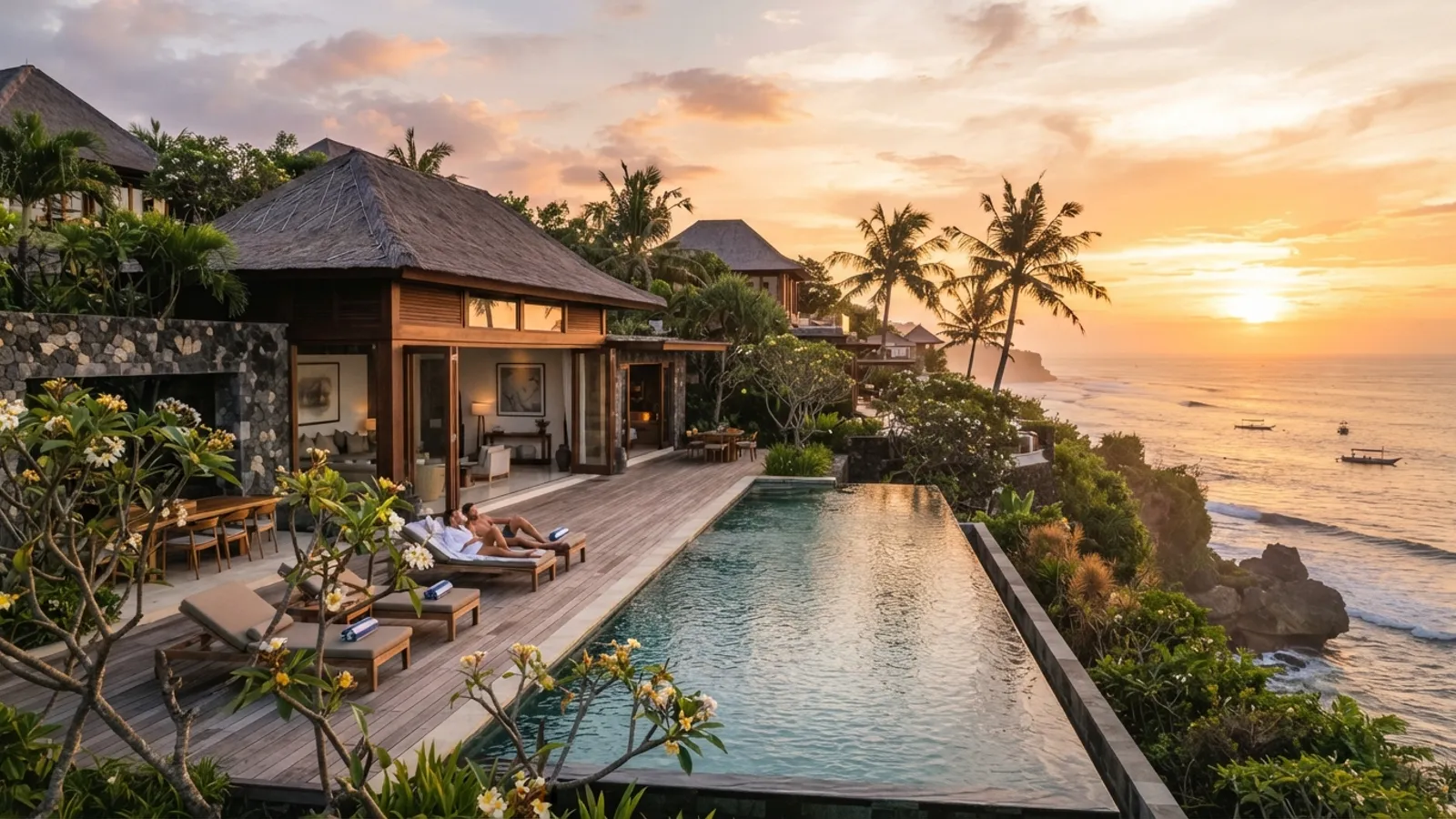
Ask three people what it costs to render a villa in Bali and you will get three wildly different answers: one says twelve hundred dollars, one says eighty, one says a single dollar. None of them is lying. The price of architectural visualization on the island in 2026 spans nearly three orders of magnitude, and the reason has nothing to do with anyone overcharging. It has to do with what you are actually buying — human hours, software licenses, revision cycles, and turnaround guarantees, versus an automated pipeline that produces an image while you finish your coffee.
If you are developing property in Bali — a boutique villa in Canggu, a cliff-edge project in Uluwatu, or a small resort anywhere in between — you need to know which tier of rendering you are paying for and why. This guide breaks the market into its three real categories, gives honest 2026 price ranges for each, and tells you plainly who each option suits. All figures below are indicative estimates for 2026, not quotes or guarantees; real prices vary by scope, complexity, and the specific provider you approach.
Why villa rendering prices vary so wildly
Before comparing options, it helps to understand what drives the number on the invoice. A render is not a fixed commodity like a bag of cement. Four things move the price more than anything else.
Human labor. The single biggest cost driver is how many skilled hours go into the image. A visualization artist modeling your villa, assigning materials, placing lights, and fine-tuning composition might spend a full day or more per view. Their time — and the studio overhead behind them — is what you pay for. Automated pipelines remove most of that labor, which is exactly why their price collapses.
Turnaround guarantees. Speed costs money in the human world. A studio that promises a finished exterior in three days charges more than one working on a three-week schedule, because rush work displaces other clients. Automated services invert this entirely: fast is the default, and it is cheap.
Revisions. Almost every price you are quoted assumes a fixed number of revision rounds. "Add a pool," "make it sunset," "swap the render to white stone" — each of those, past the included allowance, is billed. Revision policy is often where a seemingly cheap quote becomes expensive.
Detail and realism ceiling. A quick concept image for an internal deck and a magazine-grade hero shot destined for a glossy spread are not the same product. The higher you push photorealism, custom modeling, and art direction, the more the price climbs — and the more a human specialist earns their fee.
Keep those four levers in mind as we go through the three categories, because each category makes a very different trade among them.
Option 1: Local visualization studios
Indicative 2026 price: roughly $500-2000 per render. Turnaround: about 1-3 weeks. Revisions: a set number included, then a surcharge per additional round.
Local architectural visualization studios are the traditional, premium end of the market. These are small teams — often two to ten people — who model your project in professional 3D software, build a full digital scene, and render it on powerful hardware. On Bali you will find them clustered around the design-heavy areas, serving architects, developers, and hospitality brands.
What you get
A full production. You hand over your plans, sketches, references, and material choices, and the studio recreates the villa as a detailed 3D model. They dress the scene with tropical planting, water, furniture, and carefully art-directed lighting. The output is typically a set of high-resolution stills — sometimes an animation or a walkthrough — polished to a standard suitable for print, large-format display, and marketing campaigns. You also get a human relationship: a project manager, a briefing call, and someone accountable for the result.
Pros
- Top-tier realism and art direction. For hyper-detailed, bespoke, magazine-grade imagery, a good studio is still hard to beat. A skilled artist makes composition and lighting decisions an automated tool cannot.
- Complex and custom scenes. Unusual geometry, intricate interiors, specific brand furniture, aerial context shots — studios handle the awkward, one-off requests.
- Accountability. You have a contract, a named contact, and recourse if something is wrong.
Cons
- Expensive. At $500-2000 per view, a full villa presentation with several angles quickly reaches four or five figures.
- Slow. One to three weeks is normal, and rush jobs cost extra. That does not fit a fast-moving deal.
- Revisions add up. You get a fixed number of rounds; change your mind often and the surcharges accumulate. Big directional changes late in the process are painful and pricey.
Who it suits
Developers and hospitality brands producing final, high-stakes imagery: the hero shot for a landing page, print advertising, a magazine feature, or a large-format sales-gallery display. If the image will be seen by thousands and represents a multi-million-dollar project, the studio premium is justified. It is the wrong tool for early-stage exploration.
Option 2: Freelancers
Indicative 2026 price: roughly $100-500 per render. Turnaround: variable, from a few days to a couple of weeks. Revisions: usually negotiable and included within reason.
Between the studio and the fully automated service sits the freelance visualization artist. On Bali this includes local talent and remote freelancers working with island clients through the usual platforms. It is the most variable category by far — quality, speed, and reliability depend almost entirely on the individual.
What you get
It depends on who you hire. A strong freelancer delivers work approaching studio quality at a fraction of the price, because you are paying one person's time without the studio overhead. A weaker one delivers something that looks fine at thumbnail size but falls apart under scrutiny. You generally get one person handling everything, which means direct communication but also a single point of failure — if they get sick, travel, or take on too much, your timeline slips.
Pros
- Good value in the middle. For concept-to-decent-final work, a solid freelancer offers most of the quality at a meaningfully lower price than a studio.
- Flexible and personal. You deal directly with the person doing the work. Small tweaks are often quick and cheap, and a good freelancer will go the extra mile.
- Range of styles. You can shop for someone whose portfolio matches the exact aesthetic you want.
Cons
- Wildly inconsistent quality. This is the core risk. Portfolios can be misleading, and the gap between the best and worst freelancers is enormous.
- Unpredictable timelines. With no studio backing them, a single freelancer's schedule is fragile. Deadlines slip more often here than anywhere else.
- Reliability risk. Communication gaps, ghosting, and half-finished jobs are real hazards, especially at the cheaper end.
Who it suits
Buyers with a moderate budget who need something better than a rough concept but cannot justify studio prices — and who have the time to vet portfolios carefully, check references, and manage the relationship. If you find a reliable freelancer whose style you trust, this can be the sweet spot. Finding that person is the hard part.
Option 3: Online and automated services
Indicative 2026 price: roughly $1-15 per render. Turnaround: minutes. Revisions: unlimited, by rewriting a text instruction.
The newest category, and the one that has reshaped the low-to-mid end of the market, is the online automated rendering service. You upload a sketch, a 3D-model export, a floor plan, or a photo of the empty plot, describe what you want, and a purpose-built engine returns a photorealistic image in roughly thirty to sixty seconds. Tropico Render is built for exactly this — villa, tropical, and resort projects on the island, with sketch-to-render, plan-to-3D, and place-on-plot flows.
What you get
Speed and volume. Instead of commissioning a single expensive image, you generate many, cheaply, and iterate live. You refine by typing — "add a pool," "make it golden hour," "white stone instead of concrete" — and the engine returns an updated version in under a minute while preserving your camera, aspect ratio, and design. There is no briefing call, no queue, no per-revision surcharge. What you do not get is a human art director making bespoke composition decisions or hand-modeling unusual custom geometry.
Pros
- Radically cheap. At a dollar or a few dollars per image, you can produce a full set of angles for less than a single studio revision would cost.
- Instant. Minutes, not weeks. You can iterate inside a client meeting or a late-night deck sprint.
- Unlimited, painless revisions. Change anything by rewriting a sentence. No surcharge, no waiting, no awkward conversation about scope.
- Consistent baseline quality. The output is predictable — you know roughly what you will get every time, which is more than can be said for the freelance market.
Cons
- A ceiling on the highest-end bespoke work. For hyper-detailed, one-of-a-kind, art-directed magazine shots, a top studio still has the edge. An automated engine encodes excellent defaults, but it will not invent a wholly custom, human-crafted composition.
- Less hand-holding. There is no project manager. You drive the process yourself, which is fast but assumes you know what you want.
- Very unusual geometry occasionally benefits from a human modeler's touch.
Who it suits
Almost everyone doing everyday visualization: architects exploring options, agents marketing a listing, developers filling a pitch or investor deck, and anyone posting to social media. For the vast majority of villa rendering needs — which are about communicating a design quickly and affordably, not printing a coffee-table book — this is now the default choice.
Side-by-side comparison
| Option | Price per render (2026 est.) | Turnaround | Revisions | Best for |
|---|---|---|---|---|
| Local studio | $500-2000 | 1-3 weeks | Set number, then surcharge | Final magazine-grade and print imagery, hero shots, complex custom scenes |
| Freelancer | $100-500 | Days to weeks (variable) | Usually negotiable | Mid-budget concept-to-final work, when you can vet the person |
| Online / automated | $1-15 | Minutes | Unlimited, by text | Fast iteration, decks, listings, social media, everyday exploration |
All figures are indicative 2026 estimates and vary by scope and provider.
Which should you choose? By use case
The honest answer is that different jobs call for different tools. Here is how the choice breaks down by what you are actually producing.
Pitch deck
You need several clear, attractive images fast, and the deck will be revised repeatedly as the concept evolves. Automated services win decisively here. The low cost and unlimited text-based revisions mean you can regenerate every time the concept shifts, without a studio invoice for each change. Paying studio rates for imagery that will be replaced next week makes no sense.
Investor deck
Slightly higher stakes — the images need to look credible and polished to people writing checks — but investors are evaluating the deal, not the pixel-level realism. Automated services are still the right call for most projects, giving you polished, consistent visuals cheaply. If a single flagship image will anchor the whole raise and the project is very large, consider commissioning one hero shot from a studio and generating everything else automatically.
Social media
High volume, fast turnaround, constant fresh content, and a small budget per post. Automated services are the only sensible choice. At a dollar an image you can post daily; at studio prices you could afford one post a month. The realism ceiling of automated tools is far above what a phone screen demands.
Final, magazine-grade work
The glossy print feature, the large-format sales-gallery display, the once-in-a-project hero shot that thousands will see. This is where a local studio still earns its premium. For genuinely hyper-detailed, bespoke, art-directed imagery on a flagship project, a skilled human artist remains hard to beat, and the cost is justified by the stakes. A good middle path is common: use automated rendering for all the fast, iterative, everyday work, and reserve a studio commission for the handful of final images that truly need it.
The bottom line
There is no single "right" price for villa rendering in Bali — there are three markets serving three different needs. Studios ($500-2000) sell craftsmanship and accountability for final, high-stakes imagery. Freelancers ($100-500) offer middle-ground value if you can find a reliable one. Online automated services ($1-15) win overwhelmingly on speed and price for the everyday work that makes up most rendering needs, while conceding the very top of bespoke, magazine-grade production to the studios.
For most people developing or marketing property in Bali, Canggu, or Uluwatu in 2026, the smart move is to make automated rendering your default and reserve the studio premium for the rare image that genuinely warrants it.