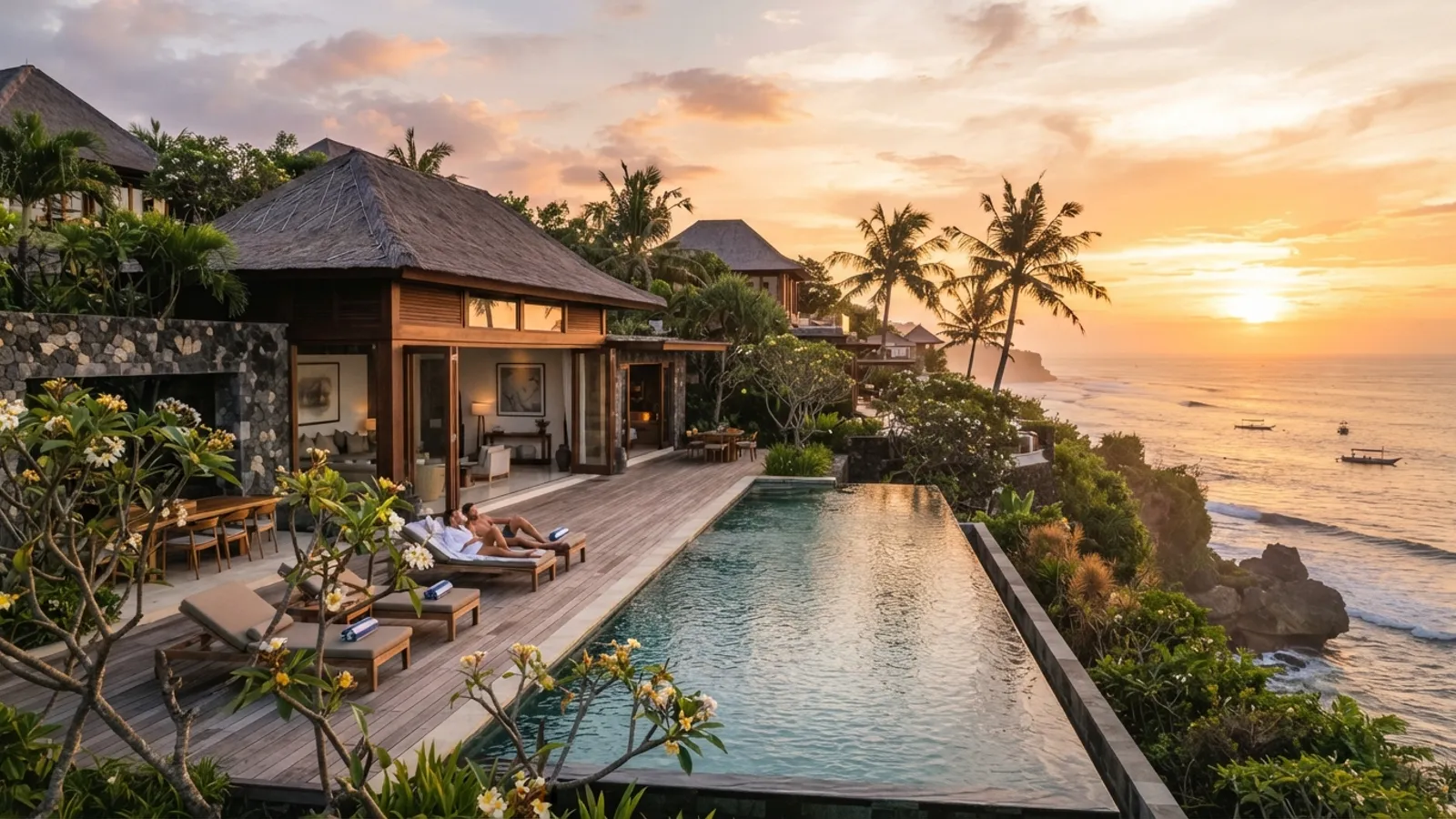
Bali has quietly become one of the most active villa-building markets in the world. Land in Canggu, Uluwatu and Ubud changes hands at prices that would have seemed absurd a decade ago, and almost every plot ends up with a villa on it — a rental, a second home, or a boutique development of four to twelve units. If you are designing, buying, selling or marketing one of these properties, the first question is almost always the same: what style are we building?
That question matters more than it looks. Style drives cost, rental yield, the type of guest you attract, and how the property photographs — which, on an island where 90% of bookings start on Instagram or Airbnb, is close to everything. This guide walks through the five villa styles that dominate Bali in 2026, what defines each one, where on the island they cluster, who buys them, and what it costs to visualize a design before a single brick is laid. Because that last part has changed dramatically: a photorealistic render that cost a studio 500 to 2000 USD a few years ago now costs 1 USD and lands in under a minute.
1. Tropical Modernism
Tropical modernism is the default language of contemporary Bali. If you picture the "new Bali villa" — clean horizontal lines, a flat or low-pitched roof, walls that slide open to a pool — you are picturing tropical modernism. It takes the clarity of mid-century modern architecture and adapts it to the tropics: deep overhangs for shade, cross-ventilation instead of relentless air conditioning, and a blurred boundary between indoors and out.
Signature features
The style is defined by openness. Living areas are frequently walled on only two or three sides, with the fourth dissolving into a covered terrace and then a pool. Ceilings are high, sightlines run straight through the building, and the pool is almost always the visual anchor — often an infinity edge, often lit from within at night. Volumes are rectilinear and stacked with intent; you see floating staircases, cantilevered upper floors and generous glazing framed in slim black or bronze aluminium.
Materials
Tropical modernism leans on a restrained but tactile palette: polished or micro-cement floors, off-form concrete, teak and merbau timber for decking and screens, and travertine or terrazzo around the pool. Glass is used generously but shaded. Greenery is treated as a material in its own right — a wall of tropical planting is as deliberate as a slab of stone.
Where it is popular
This is the signature style of Canggu, where surf culture and design-forward expat money have produced entire streets of modernist villas. You will also find it heavily in Berawa, Pererenan and increasingly across Seminyak, where the lifestyle-and-rental crowd wants something that photographs as sleek and current.
Target buyer
Tropical modernism sells to investors and design-literate second-home buyers in their 30s and 40s. It rents extremely well on Airbnb because it delivers the exact aesthetic guests are searching for, and it appeals to European and Australian buyers who want a home that feels contemporary rather than "themed."
Visualization cost
Because tropical modernism lives and dies on how light moves through open space, visualization is critical — and it is exactly what render engines handle best. A traditional architectural studio would charge 500 to 2000 USD per view for this kind of interior-exterior glazing and pool lighting. With Tropico Render the same photorealistic frame costs 1 USD and is ready in roughly 30 to 60 seconds, so you can test three roof heights and two pool positions for the price of a coffee.
2. Joglo-Style (Traditional Javanese and Balinese)
The joglo is the antithesis of the modernist box, and it is having a strong revival. Originally a traditional Javanese house form, the joglo is defined by its dramatic pyramidal roof rising from a square core supported by four central pillars called soko guru. Many of the joglos now standing in Bali were dismantled in Java, shipped across, and reassembled by specialist teams — genuine antique timber structures that can be a century old.
Signature features
The steep, soaring roof is everything. Under it sits an open-plan pavilion with almost no interior walls, so the space breathes and the hand-carved timber joinery is on full display. Interlocking joints, carved brackets and a warm, cathedral-like ceiling define the interior. In modern Bali usage, a joglo is often the centerpiece — the living or dining pavilion — surrounded by contemporary bedroom blocks with proper walls and air conditioning.
Materials
Reclaimed teak is the heart of the style: aged, dense, and full of grain. It is paired with natural stone, terracotta and clay roof tiles or alang-alang thatch, rattan furniture and woven textiles. The whole palette is warm, brown and earthy — the opposite of the cool greys of modernism.
Where it is popular
Joglos cluster in the cultural heartland: Ubud and the surrounding rice-terrace villages, and along the older, quieter east coast around Sanur, where the market rewards heritage and calm over nightlife.
Target buyer
The joglo appeals to buyers who want authenticity and a connection to Balinese and Javanese craft — often older, often repeat visitors to the island, and boutique retreat operators who use the drama of the roof as a signature. It also draws wellness and yoga-retreat developers.
Visualization cost
Rendering a joglo is genuinely difficult by hand: the intricate carved timber, the thatch texture and the way warm light filters through an open pavilion are exactly the details a cheap render botches. A studio capable of doing it justice bills 500 to 2000 USD. Tropico Render reproduces the timber grain and thatch believably for 1 USD per image, which lets a restorer or developer preview a reassembled joglo before committing to shipping tonnes of antique wood.
3. Minimalist Bali
Minimalist Bali is what happens when tropical modernism is stripped even further — fewer materials, fewer gestures, more silence. Where modernism celebrates the drama of open volumes and pool lighting, the minimalist villa is about restraint, monochrome, and the play of light and shadow on plain surfaces. It is the style most influenced by Japanese and Scandinavian sensibilities, filtered through a tropical climate.
Signature features
Expect microcement or plaster walls in a single warm off-white or grey tone, running unbroken from floor to ceiling. Openings are precise and framed like paintings. There is very little furniture, and what exists is low, simple and built-in. Curved, rounded-arch doorways and organic "wabi-sabi" plaster finishes have become a signature of the newest minimalist builds. Landscaping is sparse and sculptural — a single frangipani tree against a blank wall rather than a jungle.
Materials
The material list is deliberately short: travertine, limewash and microcement, pale timber, and linen. Texture does the work that colour and ornament do in other styles. Even the pool is often finished in a pale, sandy tone rather than the classic blue, so it reads as part of the same muted composition.
Where it is popular
Minimalist villas have spread fastest through the design-driven pockets of Canggu and Pererenan, and through the newer boutique developments in Seminyak. It is the current darling of architecture-focused Instagram accounts, which drives its rental appeal.
Target buyer
This style attracts a younger, aesthetically fluent buyer — creative professionals, remote founders and brands that want a "quiet luxury" backdrop. It photographs beautifully with minimal styling, which is a real financial advantage for short-term rental owners who cannot afford a stylist for every shoot.
Visualization cost
Minimalism is unforgiving: with so few elements, every proportion and every shadow has to be right, and that is precisely what you want to test before building. Hand-rendering these subtle plaster and light effects at a studio runs 500 to 2000 USD. At 1 USD per render, Tropico lets you iterate on wall tones and arch shapes dozens of times, which is the only sane way to nail a style whose entire value is in getting the details exactly right.
4. Jungle Retreat
The jungle retreat trades the pool-and-terrace formula for immersion. These villas are designed to disappear into dense tropical greenery, often on a slope above a river gorge, so that from inside you see nothing but canopy. Where a Canggu modernist villa faces a street, a jungle retreat faces the forest and turns its back on the world.
Signature features
The defining move is the connection to the landscape: enormous openings, glass walls, and bedrooms or bathtubs that look straight into the trees. Many use bird's-nest or A-frame silhouettes, elevated decks and suspended walkways to sit lightly on the terrain. Outdoor bathrooms open to the sky are almost a requirement. The soundtrack — river, insects, birds — is part of the design brief.
Materials
Natural and local materials dominate: bamboo (sometimes as the primary structure in the most ambitious builds), reclaimed timber, stone gathered from the river, and thatch. The aim is for the building to read as an extension of the forest rather than an intrusion into it, so raw, unpolished textures are preferred over anything glossy.
Where it is popular
This is the signature of Ubud and the river valleys around it — Tegallalang, Payangan and the areas edging into the central highlands. It also appears in the greener parts of the north and east, anywhere with a slope, a river and a view of jungle rather than surf.
Target buyer
Jungle retreats sell to wellness-oriented buyers, retreat operators, and travellers who want nature and privacy over beach clubs and nightlife. They command premium nightly rates precisely because the experience is scarce and impossible to fake in a flat, built-up neighbourhood.
Visualization cost
A jungle retreat is defined by its relationship to a specific, chaotic natural setting — dense foliage, dappled light, a view down into a gorge — and that is notoriously expensive to render by hand, easily 500 to 2000 USD for a convincing frame. Tropico Render generates that lush, light-filtered context automatically for 1 USD, so a developer can show a buyer exactly how the villa will sit inside its jungle before clearing a single square metre.
5. Clifftop Luxury
At the top of the market sits clifftop luxury: large villas perched on the limestone cliffs of the southern peninsula, engineered around a single, non-negotiable asset — the ocean view. These are the trophy properties, frequently 300 square metres and up, with helicopter-pad price tags to match.
Signature features
Everything is organised around the horizon. Infinity pools are designed to visually merge with the Indian Ocean; living pavilions are fully retractable so the sea is present from every seat; and the architecture is engineered to cling to steep, dramatic terrain. Multiple levels cascade down the cliff, connected by staircases and lifts, with the best sunset-facing spots reserved for the pool and master suite.
Materials
The palette is premium and durable, because salt air is brutal: natural stone cladding, large-format porcelain, marble, bronze and stainless fittings rated for the coast, and vast panes of structural glass. Landscaping uses hardy, wind-tolerant tropical species. The finish level is noticeably higher than anywhere else on the island.
Where it is popular
This style belongs almost entirely to Uluwatu and the wider Bukit peninsula — Bingin, Pecatu, Nyang Nyang — where the cliffs and the surf breaks create the views that justify the price. A handful of comparable properties appear on other elevated coastal stretches, but Uluwatu is the undisputed capital.
Target buyer
Clifftop luxury targets high-net-worth buyers, luxury-brand hospitality operators, and investors chasing the top of the nightly-rate market. These are the villas that appear in design magazines and command four-figure USD nightly rates in high season.
Visualization cost
For a property at this price point, visualization is not optional — buyers and financiers expect to see the finished result before committing millions. A high-end studio render of a clifftop villa with infinity pool and ocean context is firmly in the 500 to 2000 USD range, and a full set runs into serious money. Tropico Render produces the same photorealistic ocean-and-pool frame for 1 USD in under a minute, letting the developer test dozens of pool-edge and glazing options without a five-figure visualization budget.
Quick Comparison
| Style | Where on Bali | Vibe | Render cost |
|---|---|---|---|
| Tropical modernism | Canggu, Seminyak, Berawa | Open, sleek, indoor-outdoor | 1 USD with Tropico vs 500–2000 at a studio |
| Joglo (traditional) | Ubud, Sanur, rice-terrace villages | Warm, heritage, hand-carved | 1 USD with Tropico vs 500–2000 at a studio |
| Minimalist Bali | Canggu, Pererenan, Seminyak | Quiet, monochrome, restrained | 1 USD with Tropico vs 500–2000 at a studio |
| Jungle retreat | Ubud, river valleys, highlands | Immersive, natural, private | 1 USD with Tropico vs 500–2000 at a studio |
| Clifftop luxury | Uluwatu, Bukit peninsula | Dramatic, premium, ocean-facing | 1 USD with Tropico vs 500–2000 at a studio |
Choosing a Style — and Proving It Works
In practice, plenty of Bali villas blend these five languages: a modernist bedroom block wrapped around a genuine joglo pavilion, or a minimalist clifftop house that borrows the openness of tropical modernism. The style you choose should follow three things — the location, the buyer or guest you are targeting, and the rental numbers those two produce. A joglo makes little sense on a treeless Bukit clifftop; a stark minimalist box can feel out of place deep in the Ubud jungle.
Whatever direction you pick, the decision is far easier to make when you can see it. The old workflow — brief a studio, wait a week, pay 500 to 2000 USD per view, then discover the roofline is wrong — actively discourages experimentation. When each render costs 1 USD and arrives in under a minute, you can put the same villa in three different styles side by side, show them to a client or a co-investor, and let the images settle the argument. That is the practical reason the economics matter: cheap, fast visualization does not just save money, it changes how many options you are willing to explore before you build.
If you are weighing up a plot in Canggu, Uluwatu or Ubud, or preparing a development for sale, start by rendering the styles that fit your location and see which one photographs best for your target guest.