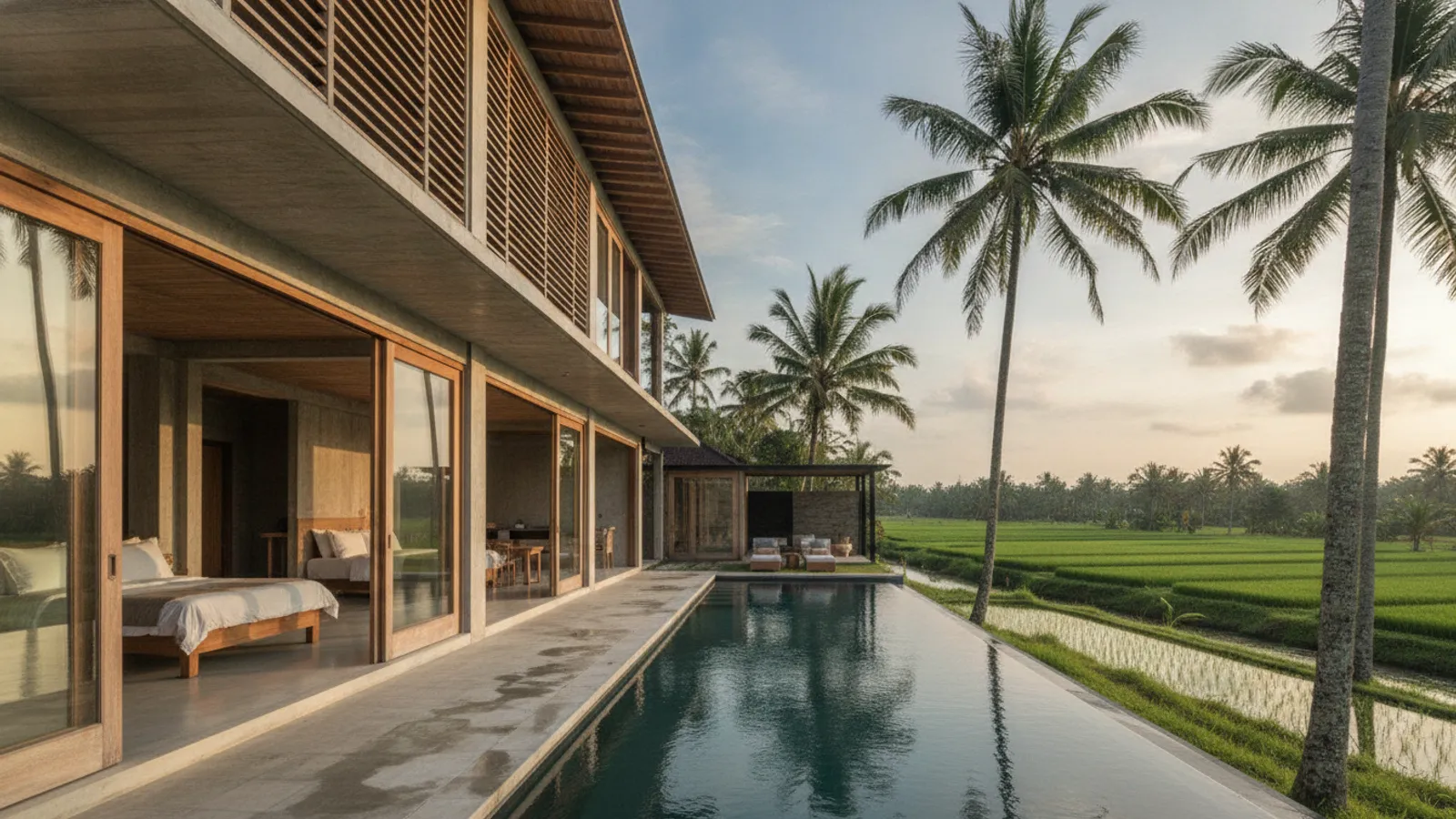
The message lands on a Monday morning. An investor is flying into Bali on the following Monday, and they want to see what the villa on your plot in Canggu will actually look like before they commit. Right now you have a floor plan, a rough massing model, maybe a couple of reference photos of the style you are chasing — and seven days. No finished visuals, no time to commission a three-week studio package, and a very real deadline that will not move because a plane ticket is already booked.
This scenario is more common than most people admit. Land deals, pitch meetings, pre-sales for off-plan villas, a partner who suddenly wants to "see it before we talk numbers" — the timeline collapses and you are left asking a simple question: what can I realistically get in under a week, and what is it going to cost me?
This guide is an honest answer. It walks through the three fast routes available in 2026 — a rush studio job, a freelancer, and automated online rendering — what each can and cannot do inside seven days, a day-by-day plan you can actually follow, the specific ways a rushed render goes wrong, and how to de-risk the whole thing so you walk into that meeting with images you are proud of rather than embarrassed by.
What "under a week" actually means for each option
"Under a week" sounds like plenty of time until you break it down. A villa visualization is not one task; it is modeling, materials, lighting, camera work, rendering, and then the part everyone forgets — revisions. The bottleneck is almost never the final render. It is the back-and-forth to get the direction right. So the real question for each option is not "can it produce an image in seven days" but "how many rounds of correction does it leave room for."
The rush studio job
A professional archviz studio can absolutely deliver in a week. The catch is that "rush" is a pricing tier, not a discount. To jump your project ahead of everyone else in the queue, a studio reallocates artists, works evenings, and charges for the disruption. Expect a rush surcharge on top of an already premium base rate.
What you get is genuinely high quality: correct materials, considered lighting, professional composition. What you lose is flexibility. On a compressed timeline a studio will typically lock the scope hard and cap revisions — often one or two rounds, sometimes framed as "minor adjustments only." If you look at the first draft and realize the whole style is wrong, or the client wants the pool moved and the roofline changed, you are either paying more or accepting what you have. The speed is real, but it is bought by removing your ability to change your mind.
Realistic turnaround for a small villa set: three to six days if they accept the rush at all. Many good studios are simply booked and will decline a one-week ask outright, which is a risk in itself — you can burn two of your seven days just finding one that says yes.
The freelancer
A skilled freelance 3D artist can be faster and cheaper than a studio, and often more personally invested. The entire outcome, though, hinges on one variable you do not control: availability. A freelancer who happens to be between projects on the day you message them can turn a couple of hero shots around in three or four days. A freelancer who is mid-project cannot, no matter what they charge.
So the freelancer route is a lottery you play against the clock. You may need to message five or ten people to find one who is both free and good, and vetting quality under deadline pressure is hard — you are trusting a portfolio and a promise. When it works, it works beautifully. When the person goes quiet on day four with your deadline on day seven, you have no recourse and no backup, because you spent your buffer waiting on them.
Revisions with a freelancer are usually more generous than a rush studio, but they still cost time. Each round is an email, a wait, a render, another wait. Two or three rounds can eat most of a week on their own.
Automated online rendering
The newest option changes the shape of the problem entirely. Automated architectural visualization services generate a photorealistic image from your input in roughly 30 to 60 seconds, and you refine it by describing changes in plain text. There is no queue, no availability, no scheduling. You upload or describe your villa, get an image in under a minute, and if the roof is wrong or the light is flat or the material reads as concrete when you wanted timber, you type the correction and get a new version — same session, same afternoon.
At roughly a dollar per render, iteration stops being a budget decision. You can generate a dozen directions before lunch and not think about the cost. That inverts the entire "under a week" math: instead of one precious draft you protect at all costs, you get unlimited attempts, and the constraint becomes your own judgment rather than an artist's calendar.
The honest limits: automated rendering is superb for concept, mood, style exploration, and client-facing "here is the vibe" imagery. It is not a substitute for a metre-accurate construction visualization derived from your exact CAD model. For a one-week pitch that is usually exactly the right trade — you need to sell the feeling and the direction, not certify the setback distances.
A day-by-day plan for a one-week timeline
Here is a plan built around de-risking early and polishing late. It assumes the meeting is on Day 8 (the Monday after). The core idea: use automated rendering in the first 48 hours to lock the direction cheaply, then decide whether you even need a studio or freelancer for a final polish pass.
| Day | Task |
|---|---|
| Day 1 (Mon) | Gather inputs: floor plan, plot photos, 3–5 reference images of the target style. Write a one-paragraph brief: villa type, mood, key materials, time of day. |
| Day 2 (Tue) | Automated rendering sprint. Generate 10–15 concept directions — different angles, materials, lighting. Cost is trivial, so explore widely. Pick 2–3 favourites. |
| Day 3 (Wed) | Refine by text. Iterate the 2–3 favourites: fix the roofline, adjust the pool, warm the light, correct materials. Lock ONE clear direction and a reference set. |
| Day 4 (Thu) | Decision point. Are the automated visuals good enough for the meeting? If yes, produce final angles and stop. If you need a hand-finished hero shot, brief a freelancer or studio NOW with a locked direction. |
| Day 5 (Fri) | If polishing externally: artist works from your locked concepts (this makes them dramatically faster). If not: generate remaining views — exterior, key interior, dusk shot. |
| Day 6 (Sat) | First external draft in, or your own render set complete. Review against the brief. Note corrections precisely. |
| Day 7 (Sun) | Final revision round. Small fixes only. Assemble the deck: images in order, one line of context per shot. |
| Day 8 (Mon) | Meeting. Walk in with a coherent, locked set — not a pile of half-finished experiments. |
The reason this works is that the expensive, slow resources (a studio or freelancer) never have to do the exploratory work. You do that yourself, in hours, with automated tools. By the time a human artist gets involved, the hard decisions are made and their job is polish, not discovery — which is both faster and cheaper.
If you are choosing a plot or a style and want grounding in what actually sells in specific areas, it helps to look at local context: what a villa reads like in Canggu versus the clifftop language of Uluwatu is a real stylistic difference, and getting it right in your references saves a whole revision round.
The risks of rushing — and how to de-risk
Speed is not free even when the render is fast. The failures below are the ones that actually sink a one-week timeline, and each has a specific antidote.
Risk 1: Untextured or "unfinished" results
The classic rush failure is a render that is geometrically right but materially dead — grey plastic walls, no reflections in the pool, glass that looks like a flat panel. It happens because materials and lighting are the most time-consuming stage, and under pressure they get skipped. On a client, an untextured render reads as "not serious," and the whole pitch loses credibility.
De-risk: front-load material decisions in your brief and your references. If you are exploring with automated rendering, materials come baked into every generation, so you see the finished feel from the first attempt — that alone removes the single most common rush disaster. Never present a grey-box render to a client as if it were the vision; it is a modeling checkpoint, not a visual.
Risk 2: Wrong style entirely
You brief "modern tropical," the artist delivers "Mediterranean minimal," and now you have burned three days and half your budget on something you cannot use. Under a normal timeline this is annoying; under a one-week deadline it is fatal, because you have no days left to redo it.
De-risk: this is the single strongest argument for starting with automated concepts. Generating fifteen directions on Day 2 for a few dollars means you discover the style mismatch immediately, on your own screen, before any expensive resource is committed. You lock the direction with actual images in hand, not words that can be misread. When you then hand a freelancer or studio a chosen, approved concept, "wrong style" becomes nearly impossible — they are matching a picture, not interpreting a sentence.
Risk 3: No time left for revisions
The quiet killer. Everything runs slightly late, the first draft arrives on Day 6 instead of Day 4, and there is simply no room for the two rounds of correction every project needs. You present something you know is 80 percent right and hope the client does not notice the 20.
De-risk: build the buffer at the front, not the back. Get to a locked direction by Day 3 so that the entire back half of the week is revision time. And keep automated rendering in your pocket as an insurance policy — if an external draft comes back wrong on Day 6 and there is no time for another external round, you can regenerate a corrected version yourself in minutes rather than missing the meeting entirely.
Risk 4: Single point of failure
Betting the whole deadline on one freelancer, or one studio slot, means one person's flu or one overrun project takes your meeting down with it. There is no plan B and no time to build one on Day 6.
De-risk: keep a parallel path alive. Because automated rendering costs almost nothing and needs no scheduling, you can run it alongside a freelancer engagement as a standing backup. If the human path delivers, great, use it. If it collapses, you already have a coherent set to fall back on. Redundancy that costs a few dollars is cheap insurance against a missed pitch.
What you can realistically deliver in a day with automated rendering
Set aside the full week for a moment. Suppose it is not seven days but one — the meeting moved up, or the message came late. What can automated rendering genuinely put in your hands in a single working day?
Quite a lot. At around a dollar per image and 30 to 60 seconds per generation, a focused day looks like this:
- A morning of exploration. Twenty to thirty concept generations across different angles, materials, and times of day. You are not precious about any of them; you are hunting for the two or three that feel right. Total spend: pocket change.
- A midday lock. Pick the winning direction. Refine it by text — "warmer late-afternoon light," "swap the render to timber cladding," "widen the angle to show the pool deck." Each correction is another minute and another dollar. Five or six rounds and the hero shot is where you want it.
- An afternoon of coverage. Generate the supporting set: the main exterior, a dusk variant, a key interior, an aerial-ish establishing angle, a detail shot of the entry. By evening you have a complete, consistent deck.
That is a genuine, client-ready set of villa visuals produced between breakfast and dinner, refined entirely by describing what you want in plain language. It will not replace a stamped construction render, and it should not — but for a meeting whose purpose is to sell a feeling and a direction, it is precisely enough. The freedom to iterate without watching a budget or a calendar is the whole point: you stop rationing attempts and start actually choosing the best image.
If your project is Bali-specific, browsing the wider Bali villa context alongside the two hotspots — Canggu for the surf-town, social feel and Uluwatu for the dramatic clifftop language — helps you brief the tool with the right regional cues from the first generation.
Option comparison
Here is the honest summary of the three fast routes, side by side.
| Option | Fastest realistic turnaround | Cost | Risk |
|---|---|---|---|
| Rush studio | 3–6 days (if they accept) | Premium base rate plus a rush surcharge | May decline outright; scope locked hard; revisions capped to 1–2 rounds |
| Freelancer | 3–5 days (if available) | Mid-range; varies widely | Availability lottery; single point of failure; quality hard to vet under pressure |
| Automated online | Minutes per image, same day | ~$1 per render; iterate freely | Concept-grade, not metre-accurate CAD output; not for construction certification |
The pattern is clear. Studios buy you quality at the cost of flexibility and money. Freelancers buy you a personal touch at the cost of reliability. Automated rendering buys you unlimited iteration and zero scheduling at the cost of construction-grade precision you probably do not need for a pitch. For most under-a-week situations the smartest play is not to pick one but to sequence them: automated first to explore and lock cheaply, a human afterwards only if a hand-finished hero shot justifies it.
The bottom line
A week is enough — but only if you spend the first half locking the direction and the second half polishing it, never the other way around. The mistake that kills one-week timelines is committing an expensive, slow resource to exploratory work, discovering on Day 5 that the style is wrong, and having no days left to recover. Invert it. Explore fast and cheap, lock a real direction with images in hand, and let any human artist you bring in do the one thing they are best at: finishing a decision that is already made.
Automated rendering is what makes that inversion possible. It turns the riskiest, most iteration-hungry part of the job — figuring out what the villa should actually look like — from a multi-day, multi-thousand-dollar gamble into an afternoon of cheap, reversible experiments. Whether you use it for the whole deliverable or just to de-risk a studio brief, it is the single change that makes "the client arrives in a week" a manageable brief instead of a panic.