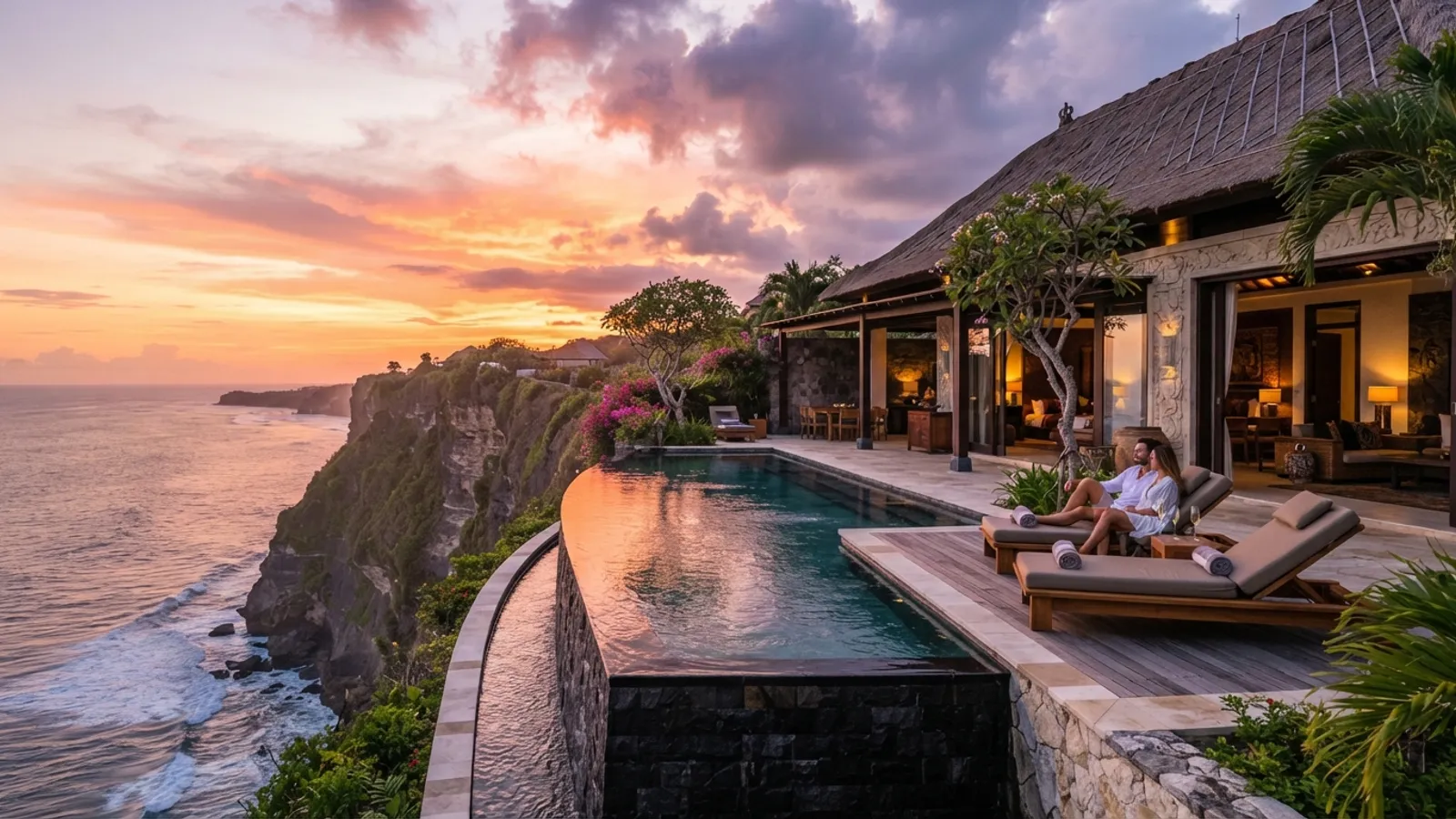
There is a moment in every villa pitch when the investor stops listening to your words and starts looking at your screen. Everything before that moment is small talk. Everything after depends on what appears there. If it is a floor plan, a spreadsheet, or a grey untextured 3D model, the temperature in the room drops. If it is a warm, photorealistic image of a finished villa perched above the Uluwatu cliffs at golden hour, the investor leans forward — and now you are negotiating terms instead of begging for attention.
This guide is about that moment. Not about your architecture, which is presumably excellent, but about the format in which you deliver it. On Bali, where foreign capital chases villa yields and dozens of projects compete for the same wallets, the studio that shows the finished feeling wins the money. The studio that shows technical drawings loses it — regardless of who has the better design. Let us break down why, and exactly what to put on the screen.
The psychology of perception: investors buy a feeling, not a floor plan
Here is the uncomfortable truth that most architects resist: an investor is not buying your building. They are buying a mental picture of an asset that already exists, generates rental income, and looks good in a listing. Your job in the pitch is to install that picture in their head as vividly and quickly as possible. A floor plan does the opposite. It asks the investor to do work — to translate lines and dimensions into a three-dimensional space, then imagine that space furnished, lit, and full of paying guests. Most investors cannot do this. The ones who can still resent being asked to.
Decisions to commit capital are emotional first and rational second. Neuroscience and every honest salesperson agree on this: people decide with feeling and justify with logic. When an investor sees a photorealistic render of the villa's pool deck at sunset, with the infinity edge dissolving into the ocean, something happens in the reward centers of the brain before a single number is discussed. They want it. The financials that follow — occupancy rates, nightly ADR, projected ROI — are no longer a cold evaluation. They are a justification for a decision the investor has already started to make emotionally.
This is why the visual is not decoration around your pitch. It is the pitch. The spreadsheet supports the image, not the other way around. When you understand this, you stop treating renders as an expensive afterthought and start treating them as the single most leveraged asset in the entire deal.
There is a second psychological layer specific to Bali investors: risk. Most are buying remotely, wiring money into a jurisdiction they may barely know, trusting a studio they met last week. A photorealistic, consistent, professional set of visuals does something a spreadsheet never can — it signals competence and reduces perceived risk. If the studio can make the picture look this finished and considered, the reasoning goes, they can probably make the building look that way too. Sloppy or missing visuals signal the opposite, and the investor's mind fills the gap with worst-case assumptions.
What to show, and in what order
Order matters as much as content. You are directing attention, building a feeling, then landing the logic. Show the wrong thing first and you lose the room before you have earned the right to talk numbers. Here is the sequence that works.
1. The hero exterior shot
Open with your single strongest image: the villa seen from its best angle, in the best light, in its real context. This is the emotional anchor of the entire meeting. It should be gorgeous, warm, and specific to the site — if the plot is in Uluwatu, show the cliffs and the ocean horizon; if it is in Canggu, show the rice-paddy greenery and the low tropical sky. The hero shot answers the only question the investor is really asking in the first thirty seconds: do I want this to exist? Everything else is detail.
2. Site and context
Once they want it, show them where it lives. A render that places the villa in its actual surroundings — the neighboring landscape, the approach road, the vegetation, the view corridor — turns an abstract building into a real piece of real estate. Bali investors care intensely about location and view, because those two things drive nightly rates. Prove the view. Prove the privacy. Prove the setting.
3. Key interiors
Now take them inside. You do not need every room — you need the three or four spaces that sell the lifestyle: the open-plan living area flowing to the pool, the master suite with its view, the kitchen, and one signature moment (a sunken bar, a spa bathroom, a rooftop lounge). Interiors convert the exterior desire into a concrete sense of living here or renting this out. Keep the styling consistent with the exterior — same time of day, same material palette, same mood.
4. Aerial and masterplan (for complexes)
If the project is more than one villa — a cluster, a boutique resort, a development — you need the bird's-eye view. An aerial render or a rendered masterplan shows scale, layout, shared amenities, and how units relate to each other and to the land. For a multi-unit investment, this is where the investor sees the business: how many keys, how the density works, where the value multiplies. A single villa needs a hero shot; a complex needs a hero shot and an aerial.
Here is the same logic in a table you can keep beside you when you prepare a deck:
| What to show | Why it matters |
|---|---|
| Hero exterior at golden hour | Creates the emotional "I want this" in the first 30 seconds |
| Site and context render | Proves location, view, and privacy — the drivers of nightly rate |
| Key interiors (3–4 spaces) | Converts desire into a concrete sense of living/renting the space |
| Aerial or masterplan | Shows scale and the business case for multi-unit projects |
| Alternate angles of hero | Removes doubt; lets the investor "walk around" the asset |
| Day and dusk variants | Signals a premium, considered product and reduces perceived risk |
Common pitfalls that quietly kill the deal
Most failed pitches are not failed by weak architecture. They are failed by weak presentation, and the mistakes repeat with depressing regularity.
Grey, untextured 3D models. Nothing drains desire faster than a clay-colored massing model shown to a non-architect. You see the design intent; the investor sees an unfinished, uncertain thing. A grey box says "not ready." A textured, lit, photorealistic image says "this exists." Never show working geometry to someone who is deciding whether to fund it.
Inconsistent style across images. When one render is bright midday, the next is moody dusk, a third has different furniture, and a fourth uses a completely different rendering style, the investor's subconscious reads disorganized. Consistency of light, palette, and mood across the whole set signals a coherent, professional product. Inconsistency signals a studio still figuring it out — and no one funds a studio still figuring it out.
Too few angles. Showing a single view of each space leaves the investor with unanswered questions, and unanswered questions become objections. What does the pool look like from the bedroom? What is behind the camera in that living room? Give them enough angles to mentally walk around the asset. Doubt lives in the views you did not show.
Slow turnaround that kills momentum. This is the silent deal-killer. The investor asks, "Can you show me the pool bigger?" or "What if the villa faced the other way?" — and the honest answer used to be, "Give me a week." But momentum has a half-life. By the time your revised render arrives seven days later, the emotional heat of the meeting is gone, the investor is looking at three other projects, and you are just another email in the inbox. The ability to answer in the room is worth more than a slightly prettier image delivered next week.
How visualization wins the pitch
Put the psychology and the pitfalls together and the strategy is obvious: your visuals must be photorealistic, consistent, plentiful, and — critically — fast. Photorealism installs the feeling. Consistency signals competence and lowers risk. Plenty of angles removes doubt. And speed lets you ride the emotional momentum of the meeting instead of watching it evaporate.
The studios closing villa deals on Bali right now are not necessarily the ones with the best software or the biggest visualization budgets. They are the ones who show a finished-looking asset the moment the investor's attention is highest, then keep that attention by responding to every "what if" instantly. They have turned visualization from a slow, expensive production stage into a live, interactive part of the conversation. That shift — from delivering renders to conversing through them — is the whole game.
If you want more on the presentation mindset, our blog has a companion guide on turning a sketch into a photo that closes the deal. The principle is identical: meet the client in the language they actually speak, which is pictures.
The role of fast, automated renders
Here is where the economics used to break down. Traditional photorealistic visualization costs hundreds of dollars per image and takes days to weeks per round. At that price and pace, you ration renders. You show three images because five would blow the budget, and you never revise live because a revision means another invoice and another week. The old cost structure forced you to under-present exactly when over-presenting wins.
Automated rendering changes the math completely. When a photorealistic render costs about one dollar and arrives in thirty to sixty seconds instead of a week, every constraint above dissolves. You can show ten angles instead of three. You can generate day, dusk, and night variants of the hero shot. You can prepare a full context set, a full interior set, and an aerial — for the price of a coffee. Abundance replaces rationing, and abundance is exactly what removes doubt and installs desire.
But the real magic is live text revision during the meeting itself. The investor says, "Make the pool bigger." You type it. Thirty seconds later, a new photorealistic render appears on the screen with a bigger pool. "What if the facade were stone instead of render?" You type it. New image. "Show me the master bedroom at sunset." Done. Instead of promising to follow up, you are having a real-time design conversation, and the investor is watching their own preferences materialize in front of them. Psychologically this is enormous: the moment an investor sees their idea rendered instantly, the project stops being yours and starts being theirs. People fund what feels like their own.
This is what Tropico Render was built to do — automated, photorealistic renders at a dollar each, generated in under a minute, with live text-based revisions you can run live in the pitch. It turns the slowest, most expensive part of the old workflow into your sharpest closing tool. The investor never has to imagine. They just look, react, and adjust — until the villa on the screen is the one they are ready to fund.
A practical pre-pitch checklist
Run through this before every investor meeting. It is the difference between showing up hopeful and showing up armed.
- Lock the hero shot. One image, best angle, best light, real context. This is what goes on screen first. Make it undeniable.
- Build a consistent set. Same time of day, same material palette, same mood across every render. Consistency reads as competence.
- Cover the sequence. Hero exterior → site/context → three or four key interiors → aerial or masterplan if it is a complex.
- Add alternate angles. At least two views of every important space, so the investor can mentally walk the asset with no unanswered questions.
- Prepare light variants. Have day and dusk versions of the hero ready — they signal a premium, considered product.
- Kill every grey box. No untextured geometry, no working views, no clay models in front of the investor. Ever.
- Set up live revisions. Have your rendering tool open and ready so you can answer "make the pool bigger" in the room, not next week.
- Match the site. If the plot is in Uluwatu, show cliffs and ocean; if in Canggu, show paddies and greenery. Location sells the rate.
- Rehearse the order. Feeling first, logic second. Open with the image, land the numbers after they already want it.
Do all nine and you will walk into the room with the one thing that actually moves capital: a finished-looking asset the investor can see, want, and shape in real time. The architecture gets you invited. The visuals get you funded.