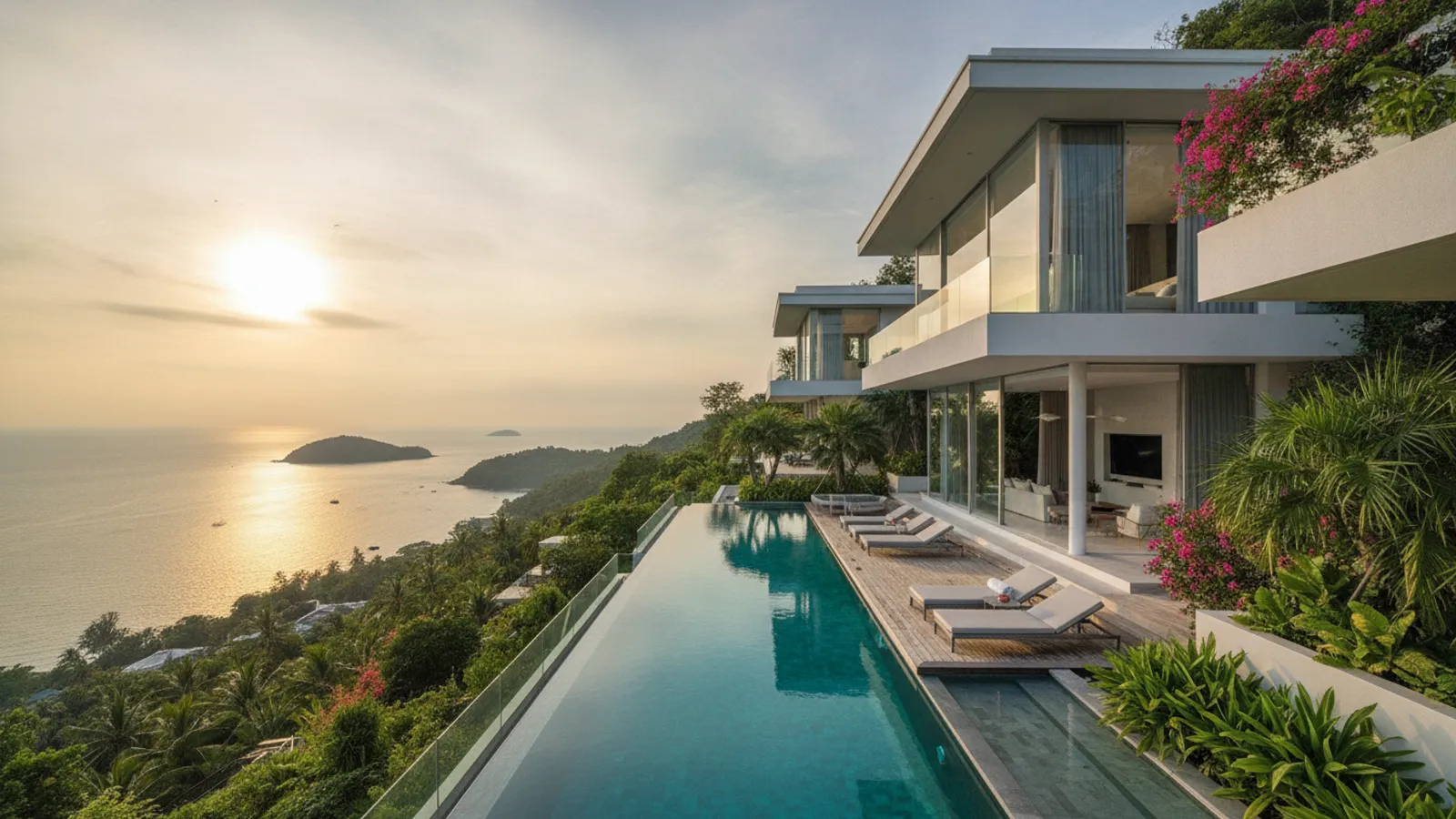
Phuket has spent the last few years transforming from a purely tourism-driven island into one of Southeast Asia's most talked-about property markets. In 2026 the villa segment sits at the center of that story. Buyers who once came for a two-week holiday now return as long-term residents, remote workers, and investors chasing rental income. Developers have responded with a wave of new hillside and beachfront projects, most of them sold long before the concrete is poured.
This article is a practical, analytical look at where the Phuket villa market stands in 2026: how the price segments break down, which locations attract the most demand, what is actually driving buyers, and — importantly for anyone selling property here — how visualization has become the deciding factor in whether an off-plan villa sells fast or sits idle. All figures below are indicative estimates drawn from market observation, not guarantees; every deal ultimately depends on plot, view, title, and timing.
Market Overview 2026
The headline story on Phuket in 2026 is durability of demand. After the volatility of the early 2020s, the island has settled into a pattern of steady absorption rather than speculative spikes. Inventory is being launched aggressively, but well-located projects are clearing quickly, and the gap between launch price and completion price on strong projects has remained meaningful.
Several structural shifts define the current market:
- A shift from condos to villas. For years the entry point to Phuket property was the branded condo. In 2026 a growing share of buyers — especially families and long-stay residents — prefer standalone villas with private pools, gardens, and separated living. The premium buyers are willing to pay for privacy has widened.
- The off-plan model dominates. The majority of villa transactions now happen before construction is complete. Developers fund builds partly through staged buyer payments, which means the sale is made on a rendering, a floor plan, and a location — not a finished product.
- Foreign and domestic capital both active. International buyers remain the visible driver in the mid and luxury tiers, but Thai and regional-Asian buyers are increasingly present, particularly in the entry and mid segments.
- Supply concentration on the west and northeast. New development clusters around the west-coast beaches and the quieter northeast, where larger plots and sea views are still available at buildable prices.
The net effect is a market where marketing quality matters more than ever. When a buyer is committing hundreds of thousands of dollars to a villa that does not physically exist yet, the visual presentation of that villa is not a nice-to-have — it is the product.
Price Segments: Entry, Mid, Luxury
Phuket villas span an enormous range, from compact two-bedroom pool villas in the interior to cliffside estates with panoramic Andaman views. It helps to think in three broad tiers. The table below gives indicative price bands and the typical buyer profile for each. Treat the ranges as estimates for planning conversations, not fixed valuations.
| Segment | Indicative price range (USD) | Typical buyer |
|---|---|---|
| Entry | 180,000 to 450,000 | First-time investors, remote workers, buy-to-let owners seeking yield on a smaller ticket |
| Mid | 450,000 to 1,200,000 | Families relocating, lifestyle buyers wanting a sea-view or near-beach home, semi-professional landlords |
| Luxury | 1,200,000 and above | High-net-worth individuals, second-home buyers, branded-residence and estate buyers prioritising view and privacy |
A few observations on how each tier behaves in 2026:
Entry segment. These are typically 2 to 3 bedroom pool villas set slightly inland or in developing areas. The buyer is highly return-sensitive and often runs the numbers as a rental business. Because the price point is accessible, competition among developers is fierce, and the projects that win are the ones that present the lifestyle convincingly. A clean, warm render of the pool at dusk does more here than any spec sheet.
Mid segment. This is the heart of the market — 3 to 4 bedroom villas with genuine design ambition, often on hillsides with partial or full sea views. Buyers in this tier are choosing between multiple similar-priced options, so differentiation is emotional as much as financial. They want to picture their family living there.
Luxury segment. Above roughly 1.2 million USD, buyers expect architectural distinction, prime positioning, and flawless presentation. Ironically, this is where amateurish visualization does the most damage: a buyer spending over a million dollars will not forgive a grainy or generic image. Presentation must match the price.
Most In-Demand Locations
Location on Phuket is not a single variable — it is a combination of view, beach access, drive time to amenities, and the character of the surrounding development. In 2026 demand concentrates in a handful of recognisable clusters.
Hillside Sea-View Areas
The strongest price growth continues to come from hillside plots with sea views. Elevated positions above the west coast — the arc running through the Kamala, Surin, and Layan hills, and the ridges above Bang Tao — command a clear premium. Buyers pay for the view, the breeze, and the sense of seclusion that a hillside villa offers over a flat inland plot.
The appeal is easy to understand and hard to photograph before the villa exists. A hillside villa's entire value proposition is the panorama from the infinity pool and the master terrace. Selling that view off-plan is precisely the challenge visualization solves — you cannot walk a buyer onto a terrace that has not been built, but you can render exactly what they will see.
Beachfront and Near-Beach
Beachfront villas remain the scarcest and most prestigious product on the island. True absolute-beachfront plots are rare and largely built out, which sustains their premium. Just behind them, the near-beach band — a short walk or a few minutes' drive from sand — is one of the most liquid parts of the market, popular with both lifestyle buyers and rental investors because holiday tenants prioritise proximity to the beach above almost everything else.
The most active west-coast zones in 2026 include:
- Bang Tao and Layan — the "Laguna" corridor, mature infrastructure, strong rental demand, a mix of mid and luxury product.
- Surin and Kamala — established prestige addresses, hillside sea views, steady luxury demand.
- Rawai and Nai Harn in the south — popular with long-stay residents and value-focused buyers, a large entry and mid supply.
- The northeast around Ao Po and the marinas — larger plots, calmer water, appealing to estate and privacy buyers.
For a wider view of how Phuket fits into the regional picture, see our Thailand overview and the dedicated Phuket page. Buyers weighing islands often compare Phuket against Koh Samui, which offers a different rhythm and price structure.
Demand Drivers
Three forces are doing most of the work behind Phuket villa demand in 2026. Understanding them helps explain why the market has been resilient and where it is likely to stay strong.
Tourism Recovery and Growth
Phuket's airport traffic and hotel occupancy have not merely recovered — they have pushed into new territory, with strong arrivals from Asia, Europe, and the Middle East. Tourism is the base layer of the whole property thesis: it fills rental villas, it introduces future buyers to the island, and it underpins the services economy that long-stay residents rely on. A healthy visitor economy is the single most important indicator that villa rental demand will hold up.
Remote Work and Long-Stay Residency
The remote-work wave that began earlier in the decade has matured into a durable resident base. Improved connectivity, long-stay visa options, international schools, and a growing community of location-independent professionals have turned Phuket from a holiday spot into a place people live for months or years. This cohort wants villas rather than hotel rooms — space to work, room for family, a pool for the downtime. They are a major reason the villa segment has outgrown the condo segment.
Rental Yields and Investment Logic
For investors, the appeal is the combination of lifestyle and cash flow. Well-located pool villas can achieve attractive gross rental yields — indicatively in the mid-to-high single digits for strong holiday-rental performers, with the best-managed properties higher, though net returns depend heavily on management costs, occupancy, and season. The dual nature of the asset — personal use plus income — is what makes a Phuket villa an easier decision than a purely financial investment. Buyers can enjoy the property and still expect it to work for them.
Taken together, these drivers create a self-reinforcing loop: tourism brings people, some become residents, residents and investors buy villas, and villa rentals serve the next wave of tourists.
How Developers and Agents Market Off-Plan Villas
Here is the central tension of the 2026 Phuket market: most villas are sold before they exist, yet buyers are more visually sophisticated and more skeptical than ever. The entire sale hinges on how convincingly a developer or agent can show a building that is still a plot of land and a set of drawings.
Visualization has become the core marketing asset in several concrete ways:
- The pitch deck. When a developer presents a project to investors or a broker network, the deck lives or dies on its renders. A crisp exterior at golden hour, a pool view, and a couple of interiors carry more weight than any amount of text about "premium finishes."
- Portal and social listings. On property portals and Instagram, the first image is the entire decision to click or scroll past. Off-plan projects with photoreal renders consistently out-perform those relying on floor plans or CAD line drawings.
- Options and personalisation. Buyers increasingly want to see the villa in "their" version — a different pool finish, a darker facade, a furnished versus unfurnished interior. Being able to show variants quickly closes deals.
- Progress storytelling. During the build, renders next to construction photos reassure buyers that the finished product will match the promise.
The problem is that traditional visualization does not move at the speed sales does. A single high-end render from a boutique studio can take days to weeks and cost hundreds to thousands of dollars per image, with revision rounds stretching the timeline further. When a broker asks for "a couple of angles for a pitch on Thursday," a multi-week studio pipeline is simply the wrong tool.
Why Fast, Automated Renders Beat Waiting on a Studio
This is where the economics of the market have quietly shifted. For a long time, photoreal visualization meant a trade-off: either pay a studio for slow, expensive, beautiful images, or accept rough sketches. In 2026 that trade-off has softened, because automated rendering can turn a model or a design reference into a photoreal image in seconds for around a dollar.
Consider what that changes for a Phuket villa seller:
- Speed matches the sales cycle. A render that lands in under a minute means the pitch deck gets built the same afternoon the broker requests it. Opportunities that used to wait on a studio queue now close inside the same week.
- Cost stops being a gatekeeper. At roughly one dollar per render, showing eight angles of a villa costs less than a coffee. Developers can visualize every unit type, not just the hero villa, so the entire range looks finished on the portal.
- Iteration is free in practice. Want the facade darker, the sky warmer, the pool lit for a sunset shot? Regenerate it. When each variation costs a dollar and a minute, testing what actually converts buyers becomes routine rather than a budget decision.
- Consistency across a whole project. A large villa development might need dozens of images to present every plot and orientation. Automated rendering produces them at a uniform quality and pace no manual studio can match on the same budget.
None of this eliminates the role of high-craft visualization for flagship luxury launches, where a hand-tuned hero image still earns its cost. But for the everyday work of selling — the pitch decks, the portal listings, the fast variants, the "can you show me this in dark timber by tomorrow" requests — automated rendering at a dollar and a minute per image is simply the better-fitted tool for how the Phuket market actually operates in 2026.
The market rewards whoever can present a not-yet-built villa most convincingly, most quickly, across the most channels. Speed of presentation has become a competitive advantage in its own right. As inventory grows and buyers compare more options side by side, the villas that sell first will keep being the ones that look finished the moment they are listed — long before the foundation is dug.
Whether you are a developer launching a hillside project above Bang Tao, an agent building listings across Phuket and Samui, or an investor modelling a value-add renovation, the ability to visualize fast and cheaply is no longer a luxury. It is part of the cost of competing. For the wider regional context, our Thailand overview puts Phuket's numbers alongside the other markets worth watching.